-65%
9

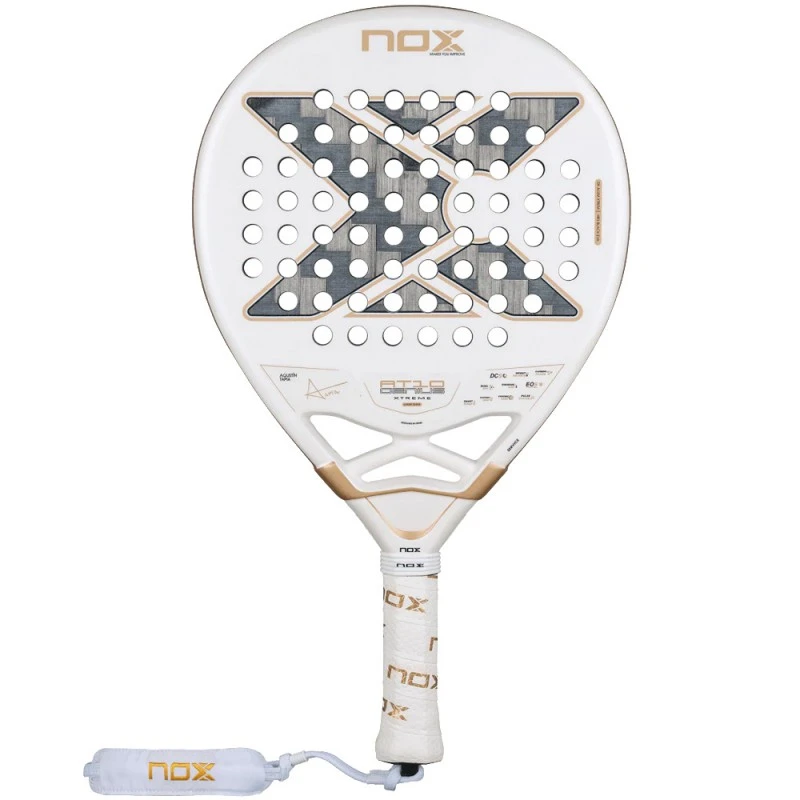
Nox AT10 Luxury Genius 12K Alum Xtrem Agustín Tapia 2026
This padel racket Nox teardrop is an ideal model for a level intermediate and stands out for Sweet Spot.
R.R.P 390,00 €
Price
137,75 €
Compare racketThis padel racket Nox teardrop is an ideal model for a level intermediate and stands out for Sweet Spot.
R.R.P 390,00 €
Price
137,75 €
Compare racketThe new Nox AT10 Luxury Genius 12K Alum Xtrem 2026, the model backed by Agustín Tapia, has left us with a very clear feeling since the first rally: here there is high-level maneuverability with a real offensive focus. It is a racket that moves easily, enters the game very well, and at the same time has that firmness that demands intention in the hit. We found it to be a very serious option for advanced players looking for balance between control and aggressiveness, without falling into a soft or excessively dry racket. If you like to dominate with initiative, but without straining your arm in every exchange, this AT10 makes a lot of sense.
By construction, it already conveys a fairly defined idea: 12K Alum Xtrem carbon, carbon fiber frame, and HR3 Black EVA rubber in a medium-hard touch configuration. When we hold it, we immediately feel that it is light on the arm, with almost outstanding maneuverability that invites us to move it fluidly in every preparation. The surface feels firm, but it does not reach that dry touch that punishes from the first hit. That mix between the rigidity of the surface and a somewhat livelier response from the rubber gives it a very marked personality.
The HR3 Black EVA felt a bit harder and also more reactive than the MLD Black Eva we remembered from previous versions, and that is noticeable in the ball exit. At low speeds, it doesn’t give too much, so it’s advisable to assist it, but when we accelerate, it responds with more bounce and speed. The medium-high balance is well distributed and did not give us a feeling of head heaviness, which is greatly appreciated in aerial play. With the new generation roughness and the matte finish across the face, the overall impression is that of a serious, precise, and versatile racket, with more offensive intention than before.
From the back, it seemed to us a very balanced racket, although with an important nuance: if the pace drops, you have to help it. The rubber does not propel the ball excessively in that context, so in slow defense or in shots where we arrive late, it’s advisable to assist well for the ball to exit with depth. On the other hand, when we prepare firmly, the response changes and a feeling of control and stability appears that is quite convincing. It is not a lazy racket, but neither is it one of those that does everything by itself.
The 12K Alum Xtrem carbon gives it a clear rigidity of the surface, although without completely erasing the sensitivity at impact. We particularly liked that in wall drops and in tricky balls, because the trajectory comes out quite clean if we hit the ball well. The HR3 Black EVA rubber recovers quickly and helps to keep the hit organized, especially at medium and medium-low speeds, where for a medium-hard touch racket, it provides a quite correct ball exit. There it feels more complete than one might think when seeing it as an offensive model.
Another good point is that the sweet spot accompanies more than usual in a racket with this level of power. Off-center hits penalize less than in other options with a similar profile, and that makes it so that in defense, it doesn’t punish us too much if we arrive a bit late. Additionally, it handles well and does not demand too much physically, something that is noticeable when it comes to surviving several consecutive exchanges from the back. What we have had to adjust is that gesture of tilting the tip down a bit to give the ball more weight, because the head does not feel heavy.
Compared to the previous AT10 12K, here we feel it a bit livelier and more offensive, although with slightly less control when the exchange accelerates a lot. The almost perfect maneuverability makes preparing the volley very easy, entering the clash comfortable, and allows us to change directions with agility. The medium-high balance is so well balanced that there is no feeling of head heaviness that sometimes ruins the net in more demanding models. In this area, it has seemed to us a very rewarding racket for those who play up front with intention.
In volleys, trays, and viboras, it is noticeable that the face offers a very usable contact to give the ball more weight and more direction. We have noticed this especially in the cut volley and in the vibora, where a dirtier and more uncomfortable ball comes out if we execute the gesture well. It is not the fastest racket on the market, but its stability on the surface and its good sweet spot make the net a very controllable space. However, if we accelerate too much or just present the racket without assisting, the ball comes out more than in the previous version, and it is advisable to play with the tip down so it doesn’t escape us.
Here the verdict is quite clear: it has plenty of power. The flat smash comes out strong and direct, with that firm and reactive touch that the combination of 12K Alum Xtrem carbon and HR3 Black EVA rubber provides, and it doesn’t require much arm for the ball to travel with speed. In the three-wall smash, we also found it very effective when we manage to impart good acceleration and lift, because the exit is lively and the ball runs well. However, the sweet spot is more centered, and when we hit outside that zone, especially higher up, the help decreases significantly, and we also lose ball feel compared to the previous AT10 12K.
Compared to the AT10 12K with MLD Black Eva rubber, this version seemed to us more offensive and bouncier. The tear shape and HR3 Black EVA give it a moderate-high power that is noticeable as we increase the pace, especially in aerial play and smashes. In exchange, the control requires more participation from the player: if we prepare well, the racket responds with a lot of stability; if we play late or too blocked, the ball comes out livelier and adjustments are needed. That is the main difference of this edition.
At slow and medium paces, the control is notable because the firm surface organizes the exit and trajectory well. When the exchange accelerates, that extra bounce from the rubber makes the ball come out more quickly, and the margin narrows a bit, something we already noticed in aggressive volleys. For this reason, we find it a very interesting racket for players with intermediate to advanced technique, capable of taking advantage of that extra help without losing the weight of the hit. Within the Nox 2026 range, if someone prefers a drier response and more control at fast pace, the version of Edu Alonso fits better into that profile.
The feeling that the sweet spot has left us is that of a medium size, quite similar to that of the previous version. It does not seem to us a racket critical with off-center hits, because it forgives better than many power rackets, and that is greatly appreciated in defense and in blocks. However, we have noticed more difference between hitting in the center and going outside that zone, where the touch becomes drier and the help decreases. It is a more centered sweet spot, so those looking for very wide sensations up top may connect better with other models.
With a weight between 360 and 375 grams, this version feels light on the arm and very easy to move. It has not tired us at all in aerial play, which adds a lot of value in long matches, where an agile racket always makes a difference. The balance is well resolved, and although it is medium-high, it does not penalize either at the net or in reaction balls. It is one of those rackets that allow you to accelerate confidently without feeling that your arm is getting heavy.
In comfort, the Pulse System also adds up, with rubber bands inside the handle to reduce vibrations. This is complemented by the Smart Strap system and the rubber prisoner to better adjust the wrist strap, as well as a comfortable octagonal cap in hand. It also incorporates the Weight Balance counterweight system, with channels at the top to modify balance and weight. All of this reinforces the idea of a well-thought-out racket for competition and adjusting sensations.
Its official retail price is €390, although at the time of writing this review, we found it for €247.99 in specialized stores. By price, it falls into the professional/top range, so here it is logical to expect premium materials, brand-specific technologies, and performance aimed at demanding players, and that fits with what it offers. As with almost all models at this level, it is normal for the price to decrease over the months, especially as the next version approaches; for this reason, many times the rackets from the previous season end up being the best purchase in terms of quality/price. If purchased at that lower price, the investment becomes much more interesting.
We see it as a racket for intermediate-high and advanced players who want a versatile option with great maneuverability and a clear offensive point. It fits very well for those who move up to the net with intention, want to volley with weight, and also need to defend effectively without straining the arm too much. If you know how to prepare the hit and take advantage of the extra bounce from the HR3 Black EVA rubber, the racket returns power with relative ease. It also makes sense for those looking for a more aggressive AT10 than the previous one.
We do not see it as clearly suitable for players who prioritize a drier touch, less bounce, and absolute control at fast pace. It is also not the most logical option for those who still do not have a sufficient technical base, because although it helps more than the previous one, it still demands precision to get the most out of it. And if what you are looking for is more ball feel on the face and a less lively response, within Nox, Edu Alonso’s model fits better. This AT10 leans more towards the player who wants initiative and a racket that pushes them to be more offensive.
The Nox AT10 Luxury Genius 12K Alum Xtrem 2026 seems to us a very well-resolved racket for those who want offensive play, great maneuverability, and a firm but not extreme touch. It has gained hitting power and bounce compared to the previous AT10 12K, although this step forward also brings a slight loss of control in faster exchanges. If your game relies on the net, smashing, and solid defense without straining the arm, it is one of the most interesting AT10s in this line. If you prefer a drier and more controlled response, we would look at other variants in the range first.
Our recommender helps you choose the racket that best suits you, your child, or your friend to give them the best gift.