-56%
8.8

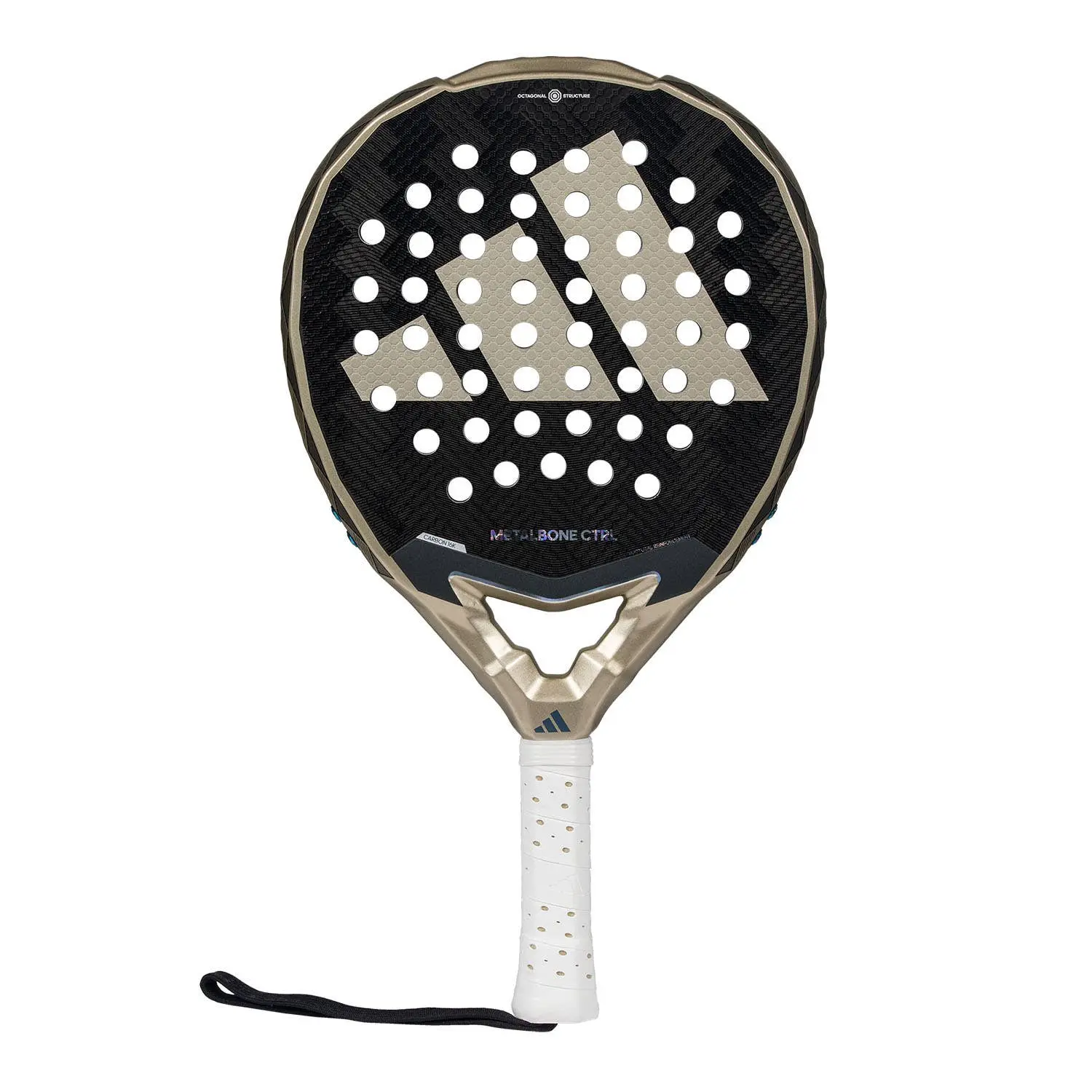
Adidas Metalbone Ctrl 3.4 2025
This padel racket Adidas round is an ideal model for a level intermediate and stands out for Ball Output.
R.R.P 390,00 €
Price
171,24 €
Compare racketThis padel racket Adidas round is an ideal model for a level intermediate and stands out for Ball Output.
R.R.P 390,00 €
Price
171,24 €
Compare racketThe Adidas Metalbone Ctrl 3.4 2025 has left us with a very clear feeling since the first rally: within this family, it is the one that feels a bit softer and more comfortable. Compared to the regular Metalbone, the Metalbone Hard, and the Carbon versions, this model leans towards a friendlier touch and a more forgiving ball exit when the pace is not too fast. Therefore, it seems like a very well-focused option for the advanced player who wants control but without entering into a paddle that is too stiff or demanding. If our game relies on touch, building the point, and receiving some help at medium and low-medium paces, this makes a lot of sense.
The first thing we perceive on the court is just that: a softer touch than the rest of the Metalbone that we have been able to compare side by side. It does not come with a hard or particularly stiff feeling, but rather with a more comfortable contact that makes it easy to get into rhythm from the first minutes. This comfort is especially noticeable when we play at medium speed, where the ball exits naturally and does not force us to push the gesture. In that context, the ball exit accompanies quite well.
However, it is not the typical control paddle with a clearly low balance. Here we find a medium-high balance, around 26.5 cm with the screws in place, and that changes the reading of the model quite a bit. In some situations, it is appreciated because it gives presence in the hit, but in others, we felt that it does not handle as well as one would expect for its control format. At medium and low-medium pace, it is easy to play because there is no need to push the ball or extend the arm too much. When the exchange speeds up or we demand more speed from our hands, that weight distribution becomes noticeable.
With that medium-high balance around 26.5 cm with the screws in place, the Adidas Metalbone Ctrl 3.4 2025 presents a rather particular behavior from the back. It is not a clumsy paddle, but rather a control version that relies heavily on its comfortable exit rather than a dry or powerful response. At medium and low-medium pace, we liked it because the ball exits well without having to push too much or extend the arm excessively. This help makes it quite easy to play comfortably from the back.
When we increase the ball speed a bit, the response remains positive as long as we do not hit with very flat strokes. If we impact without flattening the face too much, a good rebound effect similar to that of the regular Metalbone 3.4 appears, and that allows for continuity in the game quite easily. This is where we best understand this version: a paddle for building, for relying on control, and for maintaining a friendly feeling at impact. Within the range, we feel it is more designed for those who want something more comfortable in contained rhythm exchanges.
The less convincing part appears when we seek flat power from the back. In those more direct and aggressive shots, the face sinks a bit more, and the response drops a notch compared to what we expected based on its name and range. It does not feel dead, but it does convey that it is not focused on the player who lives to accelerate flat constantly. It seems much more coherent for those who prioritize touch, control, and help on slow shots than for those who want to punish every ball from the back.
In net play, it maintains quite well the same personality that we had already noticed from the back. The overall feeling remains that of a more comfortable paddle than other Metalbones, with a less dry contact and a pleasant response when we play at medium pace. This makes it an easy option to handle for blocks and construction volleys, especially if we are not looking to finish the point based on the stiffness of the plane. The medium-high balance, however, makes it feel not particularly fast in all situations.
When we press less on the face and work the ball with more touch, that rebound effect similar to that of the regular Metalbone 3.4 appears again, something that helps to give continuity to the play without demanding too much. We have not felt it as an ultra-fast hands paddle, but rather as a model that performs better when we play with some margin and let the ball exit do part of the work. Therefore, it fits better with a net player who organizes the point and seeks comfort, rather than one who lives off explosive and very short exchanges.
In the smash, a recurring idea appears: in flat power shots, it responds less because the face sinks more. We have not felt it as a paddle designed to hit the ball with dry power, but rather as a comfortable control version with a friendlier touch. The medium-high balance gives it some weight in the hit, but it does not fully compensate for that lower response when we seek maximum acceleration. If our smash depends more on timing and building the point well than on punishing flat, the paddle fits much better.
Our reading is quite clear: here comfortable control takes precedence over pure power. For being a control format, the medium-high balance gives it a somewhat distinct personality and helps it not feel empty in the hit, but when we go for flat and powerful impacts, the response drops because the face sinks more. On the other hand, at medium and low-medium pace, the ball exit is good, and the overall feel is very rewarding. This balance places it in an interesting spot for those who want control with assistance, not for those looking for an explosive paddle.
The feeling in hand and on the court is of a somewhat wider sweet spot, although it remains quite centered on the face. This fits very well with the comfortable character of the model, because when we hit well and do not flatten the ball too much, a rebound very similar to that of the regular Metalbone 3.4 appears. It is not just a matter of sweet spot, but of how that impact point supports the player who seeks touch and continuity.
The data that most conditions this section is its medium-high balance, something unusual in a paddle so oriented towards control. The comfort in ball exit is there, and at medium paces, it is easy to play, but in some situations, it is noticeable that it does not move as well as one might expect based on its format.
Its official retail price is €390, although at the time of writing this review, we found it for €380 in specialized stores. It falls within the professional/top range by price, although in terms of positioning, it fits very well as an advanced paddle for those looking for performance and specific sensations within the Metalbone family. In this range, a serious investment aimed at performance is expected, and as is often the case in padel, it is normal for prices to drop over the months, especially as the next version approaches. This is where many times last season’s models become one of the smartest purchases on the market.
We see it very focused on an advanced player who wants a more comfortable Metalbone than other options in the same family. It makes a lot of sense for those who play with control, value touch, and appreciate a good ball exit at medium and low-medium paces. If we are looking for a paddle that helps more in a paused game than in aggressive flat hitting, this version fits quite well.
We find it to be a very specific and quite coherent Metalbone with what it proposes: softer, more comfortable, and friendlier than others in the saga. If our game needs help with ball exit and we value touch over flat hitting, it is a serious option. If what we want is a drier, firmer, and more powerful response when we accelerate, there are alternatives within the family that lean more in that direction.
Our recommender helps you choose the racket that best suits you, your child, or your friend to give them the best gift.