-17%
8.8

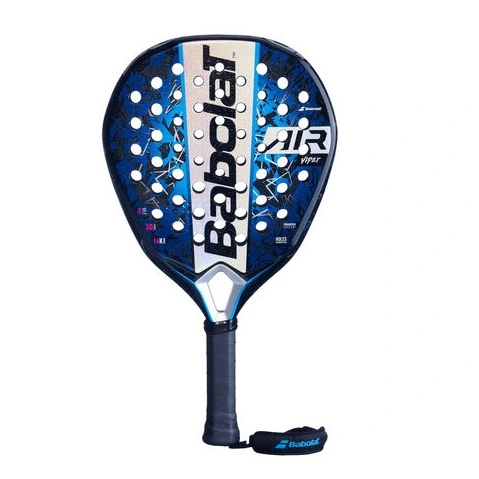
Babolat Air Viper 2025
This padel racket Babolat teardrop is an ideal model for a level intermediate and stands out for Power.
R.R.P 320,00 €
Price
265,60 €
Compare racketThis padel racket Babolat teardrop is an ideal model for a level intermediate and stands out for Power.
R.R.P 320,00 €
Price
265,60 €
Compare racketThe Babolat Air Viper 2025 has seemed to us like an advanced-level paddle very well suited for those who want control, maneuverability, and sufficient power without having to struggle with a model that is too demanding. It has a medium-hard feel, but on the court, it feels more forgiving than the previous version, especially because it doesn’t require us to push each ball as much. It is one of those paddles with which, by just assisting the hit a little, the ball already comes out deep and with good sensations. If you are looking for a permissive option, comfortable for long play, and that doesn’t physically punish you, here is a very serious proposal.
Technically, it maintains a very solid base: 16K carbon on the faces, carbon frame, EVA Sandwich foam, rough sandy finish, and a high balance that slightly rises to 25.9 cm. Even so, we barely noticed that change in balance in terms of maneuverability, as it remains a fast paddle to move and quite natural in the hand. The feel is medium-hard, with that inherent stiffness of the Viper range, but this time the impact feels less dry. The sound is no longer so board-like, which significantly changes the overall perception.
Where we have noticed the most evolution compared to the previous Air Viper is in the ball exit and in the comfort of use. The ball comes out with a bit more rebound effect, the impact transmits better sensations, and it is no longer necessary to extend the gesture so much for it to run. We also liked the work they have done on the head, as the face has been widened and the hole pattern has been adjusted to provide more stiffness in the useful area. This translates to a larger sweet spot, now of standard size or even slightly above, and a paddle that is considerably more forgiving than the 2024 model, more in line with that 2022 version that felt more comfortable.
From the back, it was previously noticeable if an Air Viper required a strong hand, and now that has softened quite a bit. We felt it quick to move and comfortable even on difficult balls, which helps a lot when defending with little time. The larger sweet spot is genuinely noticeable because it is no longer necessary to hit so cleanly to have a convincing response. At a medium or medium-low pace, with a short gesture and assisting a bit, the ball comes out deep and with good control.
The improvement in ball exit also gives it an interesting edge when we want to transition from defense to attack without having to wind up too much. On firm hits, but without pressing the face too hard, this version generates more rebound effect than the previous one and helps us accelerate the ball easily. Here, the paddle feels more rewarding, less technical, and considerably more forgiving. Moreover, when we increase the pace a bit, it doesn’t give that feeling of the ball easily going out, so control remains quite good.
However, not everything is better than in the previous Air Viper. When we play very flat and hard from the back, pressing the face well, we have noticed that the ball enters more into the plane and the response is somewhat less. In that specific scenario, the previous version had a bit more of a dry and direct hit. Here we gain comfort and tolerance, but we lose some punch on those flat hits where we seek a more aggressive exit.
With its weight around 355 g, the well-managed high balance, and a long handle that aids in acceleration, this paddle moves very well up top. In quick exchanges, we easily reached volley clashes and direction changes, which gives a lot of confidence when the net gets lively. The gesture comes out quickly, and the contact is usually clean because the sweet spot is wide and very consistent. In this area, it has seemed to us one of its most rewarding versions.
In blocks and balls where we barely assist, the improvement is clear compared to previous years. With very little gesture, the ball already comes out deep, making it easier not to leave an easy ball when we arrive forced. We also liked it in trays and viboras, as the rough sandy finish grips the ball better and allows for an extra cut, and the long handle helps generate that lever effect that makes the hit more offensive. There is just one precaution: in offensive volleys and cuts, since there is now more rebound, it’s advisable to throw the gesture down well so that the ball doesn’t go out to the glass.
Here the verdict is quite clear: it is a paddle that moves very quickly up top and has better hitting sensations than the previous one, but its light weight requires us to put in more effort if we want to unleash all the power. On the three-wall smash, it has helped us more than previous versions, especially when we don’t press the face too hard and seek to lift the ball with a lifted hit; there the rough sandy finish also helps the ball grip better. The larger sweet spot makes it easier to smash with good sensations even if we don’t hit perfectly. In contrast, on flat smashes, we have noticed a slight loss of power compared to the previous version, as the plane sinks a bit more and the response is less dry. With a new ball, it responds well, but if what you are looking for is maximum punch on the flat, it is not the most explosive Air Viper.
The overall balance is very well resolved and is likely one of the strong points of this version. We have good control at medium and medium-low pace both from the back and at the net, while also having convincing power on shots with some rebound effect and on three-wall smashes. The larger sweet spot greatly helps maintain that mix between security and ball exit. Where it falls a bit short is on very flat and strong shots, as it delivers less than the previous Air Viper. It is also advisable to adjust on offensive volleys, as that extra rebound requires closing the gesture better.
The wider head and modified hole pattern have done their job, as the sweet spot is now standard or even slightly above. On the court, this translates to less penalty when we hit slightly off-center and a more stable feel in the useful area. Very rarely have we noticed that uncomfortable bite or that ball that stays too much when we don’t hit perfectly. Compared to the 2024 version, it is a more comfortable and forgiving paddle, and in that sense, it is quite reminiscent of the Air Viper 2022.
The first thing it conveys is comfort in handling. With its approximate 355 g, it feels light, fast, and not physically demanding, which is greatly appreciated in long matches or if we come from heavier models that strain the shoulder. The 13.5 cm grip is comfortable, and the Smart Butcap system adds that practical extra of interchangeable string without complications.
Its official retail price is €320, although at the time of writing this review, we found it for €265.6 in specialized stores. By price, it falls between the advanced and entry-level professional ranges, and at that level, we expect premium materials, serious construction, and finely tuned performance, something we do see here with the 16K carbon, EVA Sandwich foam, rough sandy finish, and the work on the sweet spot. Moreover, as is often the case in padel, these models usually drop in price over the months, and when the next version approaches, even better opportunities still appear; therefore, if it drops a bit more, it could become a particularly smart purchase within its segment.
We see it very well aimed at advanced players who want a paddle with a medium-hard feel, good control on the court, and high maneuverability that doesn’t demand too much physically. It also fits very well for those looking for a more forgiving Air Viper, with better ball exit and a wider sweet spot than in the previous version. If you often feel discomfort with heavy paddles or prefer a model that helps you a bit more in defense, mid-court, and transitions, this option makes a lot of sense. On the other hand, if you are one of those who prioritize a very dry feel, little rebound, and maximum power on flat smashes, you would probably look at other alternatives within stiffer and more powerful profiles.
We see it as a more accessible, more comfortable, and more rewarding Air Viper than last year’s model. It has improved in ball exit, tolerance, and real play for many advanced players, although in exchange, it gives up a bit of dry punch on the flat. If your priority is to move quickly, play confidently, and have an offensive paddle that doesn’t punish you, this 2025 seems to us a very well-tuned version.
Our recommender helps you choose the racket that best suits you, your child, or your friend to give them the best gift.