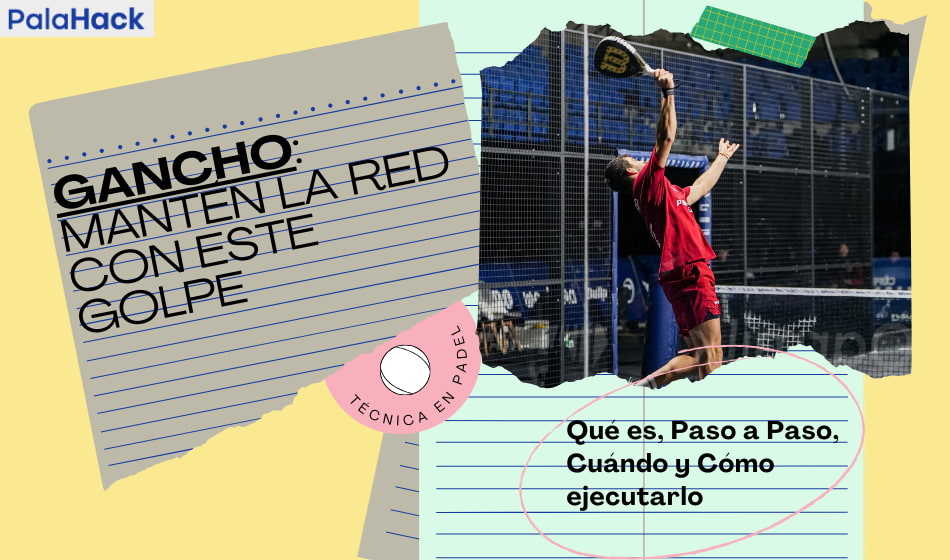
The Hook: What It Is, Step by Step, When and How to Execute It
24 de January de 2026 | Updated 17 de April de 2026
At PalaHack, we take every technical resource of padel very seriously. Often, amateur players become obsessed with the power of the smash or the refined technique of the víbora, forgetting fundamental tools for survival and counterattack. The gancho is precisely that: a shot that distinguishes the intelligent player who knows how to manage moments of aerial difficulty.
We are going to break down everything you need to know about the gancho so that it stops being a “resource” shot and becomes one of your best tactical weapons.
What is the gancho in padel
The gancho is an aerial shot executed when the opponent’s lob has slightly surpassed us or we find ourselves in an uncomfortable position, colloquially known as being “hung“. Unlike the power smash, which seeks to define the point by force, or the bandeja, which seeks depth and to maintain the net with a sliced effect, the gancho is a slower and more placed shot.
We define it as a shot of disadvantage management. When the ball is a bit behind and above us, and we don’t have the position to impart speed or lateral effect (víbora), we resort to the gancho. Its technical execution involves hitting the ball above the head, often with the body slightly arched backward, aiming to place the ball in problematic areas (like the center or the fence) with medium-low speed.
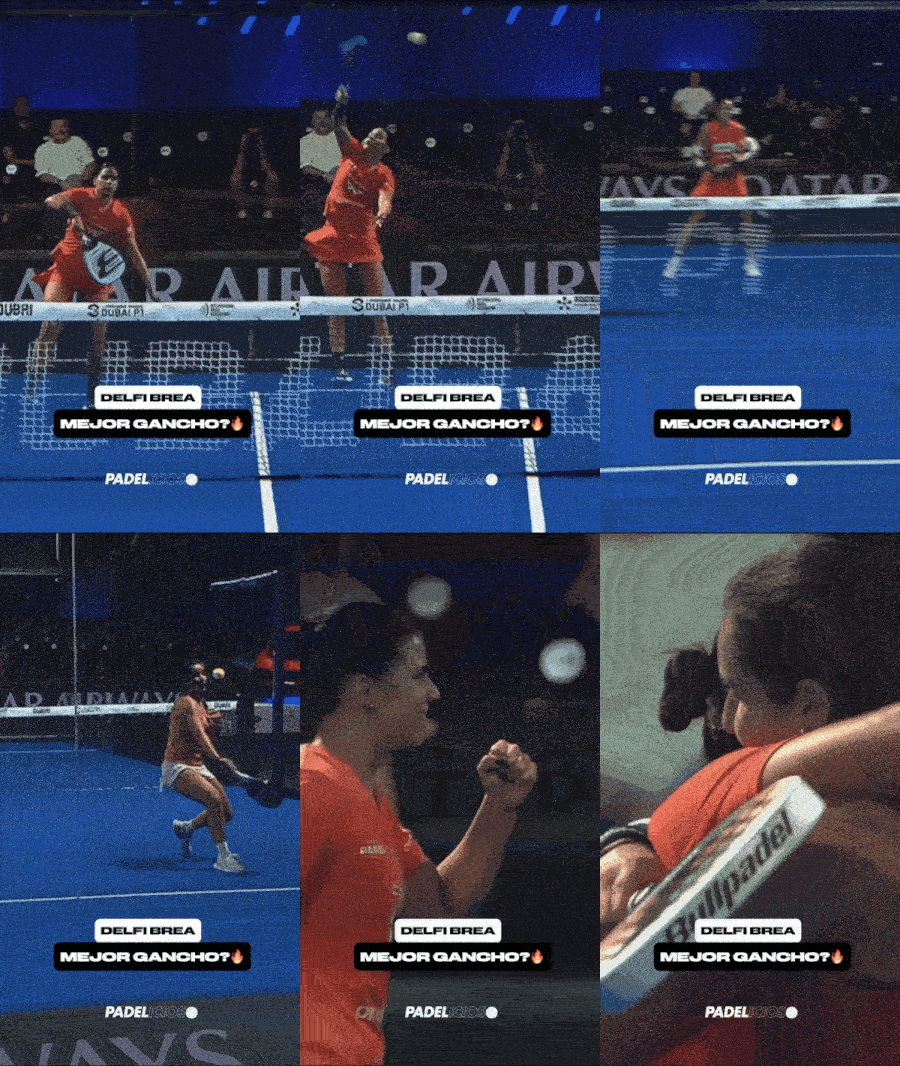
Step by step for a good gancho
The execution of the gancho requires more “hand” and sensitivity than brute force. To perform it correctly, we suggest the following sequence:
- Reading and Retreat: Upon identifying that the lob surpasses us and we cannot comfortably perform a bandeja, we must retreat laterally. The position is not as aggressive as in the smash; we are often retreating while hitting.
- Short Preparation: Unlike the power smash, the preparation for the gancho is shorter. The racket is prepared behind the head, but without a full extension of the arm backward. It is a more compact movement.
- Point of Impact: We hit the ball at the top, slightly behind the head or just above the dominant shoulder. Ideally, we aim to hit the upper part of the ball so that it “goes down” immediately.
- Soft Follow-through: We are not looking for a “whip.” The movement is one of pushing and placing, extending the arm gently towards the desired direction (usually the center). The finish is not wide; we seek directional control.
When to use it
The gancho is not a shot we should proactively seek to attack with, but rather an intelligent response to a good defense by the opponent. According to tactical analysis, we should use it in these situations:
- When we are “hung”: If the lob is good and forces us to retreat to a position where we lose offensive initiative, the gancho allows us to touch the ball and keep it in play without giving away an easy rebound.
- When opponents advance: If after lobbing us, the opponents advance to block, the slow gancho to the feet or center is vital so they cannot volley comfortably.
- To avoid losing the net: If the lob is deep but not enough to let it pass and make a wall exit, the gancho allows us to stay in the attack zone, even if it means giving up a bit of initiative.
How to improve it
To perfect the gancho and not just “pass the ball,” we recommend focusing on precision and reading the game:
- Train the “wrist”: The gancho requires sensitivity. Practice hitting high and backward balls aiming for them to drop dead just after the net.
- The rule of “simplicity”: Don’t look for strange effects. As Cata Tenorio indicates, the goal is “simple, make it go down”. If you try to slice the ball too much from an uncomfortable position, you increase the risk of error or leaving it floating.
- Work on retreating: The key to a good gancho is the legs. If you don’t adjust your steps backward well, you’ll arrive off-balance and can only “clash” with the ball.
Tactics in the gancho
This is where the gancho transforms from a defensive shot to a tactically annoying one. It’s not about hitting it anywhere.
The Gancho to the Middle
It is the queen option. When we are uncomfortable, throwing a gancho “between the two” opponents creates confusion (“is it yours or mine?”) and is the safest area to avoid the ball going to the side glass or the fence by mistake.
Lowering the ball
The primary tactical objective is for the ball to descend. If we manage to make the ball bounce near the opponent’s service line and not lift much, we neutralize their counterattack, forcing them to lift the ball again.
Gancho to the Fence (Advanced)
If we have a lot of sensitivity, we can aim for the metal mesh. However, in forced defense situations, the center is usually the option with the highest success rate and lowest risk.
Typical errors in the gancho
In our experience analyzing club players, we have detected recurring mistakes in this shot:
Trying to define
Wanting to win the point with a gancho is usually a mistake. If you are retreating and the ball has surpassed you, seeking power will only cause the ball to bounce a lot on the back glass, giving away the counterattack.
Leaving it short or high
If the gancho doesn’t go down, it becomes a “gifted ball” for the opponent to crush us or easily win the net.
Confusion of shot
A common mistake is not deciding between bandeja or gancho. If the lob falls short (in front of us), we must attack it (“smash it” or make an offensive víbora/bandeja). The mistake is trying to make a defensive gancho on a ball that called for an attack, or vice versa.
Frequently asked questions
- Is a gancho the same as a víbora? No. The víbora is an attacking shot with a lot of lateral spin and speed, hitting the ball beside the body. The gancho is a more defensive resource, with a higher/backward impact and lower speed, seeking placement and depth without rebound.
- Where should I direct the gancho if I’m a backhand player? The safest and most tactically correct option in most situations is to aim for the center of the court, between the two opponents, or towards the feet of the player who is advancing.
- When should I stop trying the gancho and let the ball pass? If the opponent’s lob is “very good” and takes us very deep, “it’s no longer convenient to make a bad bandeja” or a forced gancho. In that case, it’s better to let it pass, make a good wall exit, and restart the point.
At PalaHack we believe that mastering the gancho is mastering another tool to control the timing of the match. It is not the shot that will appear in the highlights, but it is the one that will keep you alive in the point to win it later.

PalaHack
We got the bug for this wonderful sport more than 10 years ago.
We want you to feel that, when you read one of our analyses, it is like receiving advice from those friends with whom you share the court every weekend. If something is not clear or you want to know more, do not hesitate to ask!