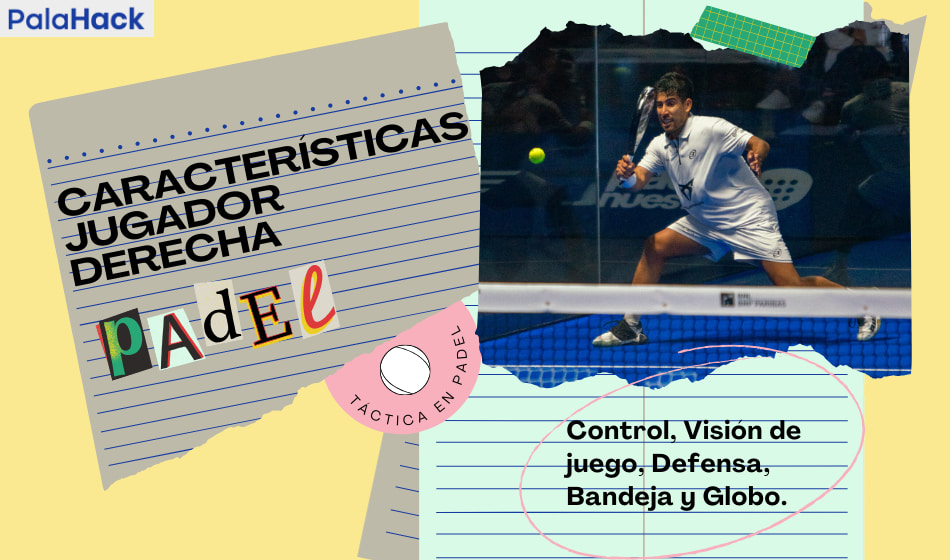
Main Characteristics of Right-Side Padel Player
22 de January de 2026 | Updated 17 de April de 2026
Playing on the right side in padel is a responsibility that requires mastering certain key aspects to maximize your performance on the court. Being an efficient right-side player not only depends on your ability to hit the ball but also on your positioning, strategy, and decision-making. The right-side player is expected to carry the weight of the point and be the tactical brain to direct the ball to the desired spot so that their backhand partner has opportunities to close the game.
From hitting technique to court positioning, each of these elements can make the difference between a win and a loss. Whether you are a beginner or advanced player, these key points we are going to break down will help you improve your game and become a much tougher opponent to beat. So, get your racket ready, and let’s discover how you can take your game to the next level.
Solid in Defense
Playing on the right in padel involves not only attacking but also being the defensive wall of the pair. If you want to master this position, you must be aware of the importance of maintaining an impenetrable defense.
First, adopt a proper ready position. Keep your feet parallel, with your legs slightly bent and the racket at chest height. This posture will allow you to react quickly to any attack. In defense, being well-positioned on the court is fundamental. When defending, position your body behind the service line and close to the back wall, but make sure not to be glued to it. Maintain a distance of about a meter and a half from the side wall to cover more space.
The key to a solid defense is coordination with your partner. Both should move as if they were one, covering the center of the court and moving laterally in sync, like the wipers of a car. This will prevent leaving unprotected spaces.
Another important point is the quick recovery after each shot. After returning the ball, immediately return to your defensive position, this is one of the keys that is often overlooked, it’s very common to stay watching what happens in the game instead of thinking about how to reactivate myself to occupy my space in the best possible way. This will allow you to be prepared for the next attack and keep the pressure on your opponents.
Being solid in defense will not only allow you to withstand rival attacks but also give you the opportunity to counterattack effectively and will be the start of a good attack.
Control
In padel, control is without a doubt one of the most important aspects to master, especially if you play on the right. Having good control over the ball will allow you not only to place it where you want but also to maintain calm and precision in critical moments of the match.
To improve your control, it is essential to work on several key aspects:
- Grip: Use the continental grip, also known as the “hammer” grip. This grip will allow you to perform all the strokes with greater mobility and precision. It is the most recommended for padel as it facilitates better impact and force transfer from the hand to the racket.
- Positioning: Maintain good positioning on the court. If you are defending, position yourself behind the service line and close to the back wall, but not too close to it. If you are at the net, position yourself in a way that allows you to attack volleys with the ball high and retreat quickly if necessary.
- Wiper technique: Move with your partner as if you were a single player, covering the center of the court and ensuring no free spaces are left. This synchronized movement will improve your coverage and control over the court.
- Shot selection: Learn to choose the right shot according to your position on the court. In defensive areas, opt for lobs and soft, directed shots. In offensive areas, take more risks and look for definitive shots.
Control is also influenced by the quality of your racket. Make sure to choose a well-balanced racket that suits your level of play and physical strength. A racket with good balance will help you maintain excellent control without sacrificing power.
Here we leave you a guide on how to choose your padel racket.
Remember, good control will not only allow you to execute more precise shots but also give you the confidence needed to dominate the game and keep the pace of the match in your favor.
Bandeja
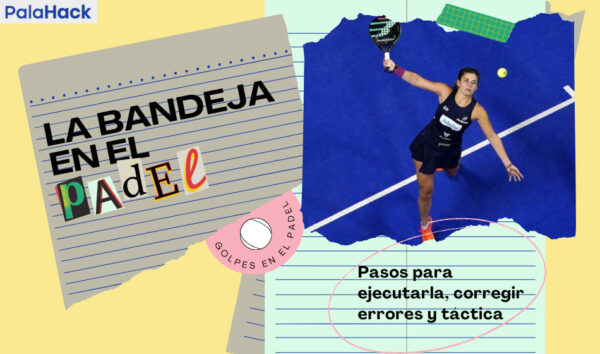
The bandeja is a fundamental shot for those who play on the right in padel. This hybrid movement between the smash and the volley is mainly used to maintain position at the net and prevent opponents from gaining ground with a lob. Mastering the bandeja will not only allow you to maintain control of the point but also wear down your opponents by forcing them into constant defense.
To execute an effective bandeja, consider the following tips:
- Ready position: Stand with your feet parallel and knees slightly bent. The racket should be aligned with your chest, holding it with your left hand for greater control.
- Shot preparation: Turn your shoulders and bring the racket back while pointing your left shoulder towards the ball. Support your left leg in front to stabilize yourself.
- Impact: Hit the ball by transferring the weight of your body from the right leg to the left. Keep the racket high and finish the movement at the height of the opposite shoulder.
- Direction: The bandeja should be a deep and controlled shot. Direct the ball to the back of the opponent’s court, preferably towards the corners to force an uncomfortable displacement of the opponent.
It is crucial not to rush and always aim to place the ball in a position that forces the opponent to defend. The bandeja should be a continuity shot, not a point-defining and closing shot. The key is to maintain pressure and wait for the right moment to attack with a decisive smash or volley.
Drive from the Back
This shot allows you to maintain control of the point and prepare the ground for an attack. Steps for a good drive when defending at the back:
- Ready position: Before executing the shot, stand with your feet parallel and aligned with your shoulders. Keep the racket supported by your left hand, aligned with your chest, and your legs slightly bent. This position will allow you to react quickly.
- Shot preparation: Turn your shoulders pointing the left shoulder towards the ball. Raise the racket back without changing its position and advance the left leg. The transfer of body weight from the right leg to the left is key for an effective shot.
- Point of impact: Hit the ball when it is aligned with your left shoulder. Finish the movement with the racket at the height of the opposite shoulder. This point of contact is fundamental to maintaining control and precision.
- Do not bend the legs: Always keep your legs bent for greater stability and control.
- Impacting too far forward or back: Make sure to hit the ball at the right moment, neither too far forward nor too far back.
- Preparing with the arm too bent or stretched: Maintain a natural and comfortable arm position.
- Finishing too low or too high: The racket should finish pointing towards the final destination of the ball.
Forehand Volley
The forehand volley is one of the most fundamental and effective shots in padel, especially for players who play on the right. Mastering this shot will allow you to maintain pressure on your opponents and control the net, a key strategic position in this sport.
To execute a successful forehand volley, it is crucial to maintain a good ready position. Keep your feet parallel and aligned with your shoulders, the racket held by the non-dominant hand, and your legs slightly bent. This posture will allow you to react quickly to the ball and execute the shot with precision.
There are several technical aspects you should consider to perfect your forehand volley:
- Shoulder turn: When starting the shot, turn your shoulders pointing the left shoulder towards the ball. This will help you prepare the racket and have better body alignment.
- Weight transfer: Transfer your body weight from the back leg to the front leg when hitting the ball. This will give you more strength and control in the shot.
- Point of contact: The point of contact with the ball should be when it is aligned with your left shoulder. Hit the ball so that the racket finishes at the height of the opposite shoulder.
The forehand volley is not just about technique, but also about strategy. Here are some tips to maximize its effectiveness:
- Place the ball: Try to direct the ball towards your opponents’ feet or towards the corners of the court. This will make it difficult for them to return and allow you to maintain the initiative.
- Use effects: Introduce sliced or topspin effects in your volleys to make the ball bounce unpredictably, complicating the opponent’s response.
- Anticipation: Keep an eye on your opponent and anticipate their movements. This will allow you to position yourself better and be ready for the next play.
Remember that the forehand volley is a powerful tool when used correctly. Practice these tips and techniques in your training to become a more complete and dominant player on the court. See you on the courts!
Game Vision
To improve your game vision, it is important to develop a capacity for quick analysis. Constantly observe the position and movements of your opponents and your partner. This will allow you to anticipate their actions and react effectively.
A good right-side player must be able to identify the opportunity zones on the court. This includes recognizing when it is the right time to attack, defend, or make a transition shot. The key is to maintain a flexible and adaptable mindset.
Some keys to optimizing your game vision:
- Observe your opponents’ playing patterns. Do they have any shot they repeat frequently? Do they prefer to play through the center or the corners?
- Constantly communicate with your partner. Good coordination can make the difference in crucial situations.
- Practice the wiper technique, moving in sync with your partner to cover the court efficiently.
- Develop the ability to read the ball’s exit from the opponent’s racket. This will give you an additional fraction of a second to react.
Game vision also involves being strategic. The best option is not always the most obvious. Sometimes, a well-placed defensive shot can be more effective than a risky smash attempt. Constantly evaluate your options and choose the one that maximizes your chances of success. This does not develop overnight; it is a continuous process that requires practice and experience. The more you play and the more situations you face, the better you will be able to anticipate what will happen on the court.
Maintain a positive attitude and openness to learning. Game vision is a skill that is perfected over time and dedication. Keep practicing, and you’ll see how your performance on the court improves significantly!
Lob
The lob is one of the most strategic and effective shots in padel. This shot allows you to gain time, reorganize your position, and force your opponents to retreat. Mastering it can be the difference between maintaining control of the point or losing it.
The hitting technique is crucial. You must hit the ball with an upward movement, ensuring that the racket is slightly open. This will help the ball gain height and depth, making it difficult for your opponents to return.
There are several ideal moments to use the lob:
- When you are in a defensive position and need to gain time.
- To surprise your opponents who are well-positioned at the net.
- To change the pace of the game and unsettle your opponents.
The direction and height of the lob are the most important points. A well-executed lob should fall near the back line and as high as possible (you don’t need to adjust to the maximum because otherwise, we will fail by hitting the ball against the glass), preventing your opponents from returning it with an aggressive smash.
Watch out, this is important! If we are very uncomfortable, the lob will not be a great option to recover the net since we will not have the desired precision, and it will most likely fall short, leading to a remate x3 or a remate x4. So what do we do? We will have to resort to a strong shot to the body or a chiquita, which will allow us to either change the pace of the game and thus receive a slower ball or a new opportunity to advance.
As you can see, padel is a sport that combines technique, tactics, and mentality, and playing on the drive is no exception.
PalaHack
We got the bug for this wonderful sport more than 10 years ago.
We want you to feel that, when you read one of our analyses, it is like receiving advice from those friends with whom you share the court every weekend. If something is not clear or you want to know more, do not hesitate to ask!