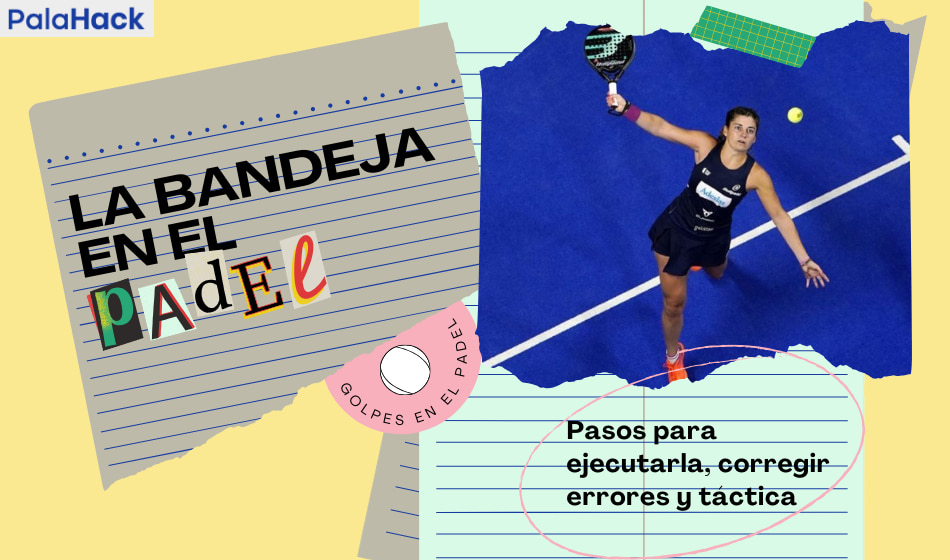
The BANDEJA in Padel: What it is, How and When to Execute it
15 de January de 2026 | Updated 17 de April de 2026
At PalaHack, we understand that padel is not just a power sport, but a physical chess game where space control is paramount. Within the technical repertoire, the bandeja stands out as the quintessential identity shot of the player who dominates the net. In this article, we break down in detail everything you need to know to turn this defensive resource into an absolute control tool and thus dominate your matches much more, making recovering the net a much simpler process in your game.
What is the bandeja in padel
The bandeja is a purely specific connection shot in our sport that is executed from the net position when the opponent tries to lob over us. Unlike the smash, whose goal is usually direct definition, the bandeja aims to neutralize the opponent’s initiative and allow us to recover or maintain the offensive position at the net. At PalaHack, we define it as a continuity shot: we prefer to “suffocate” the opponent with low and tricky balls rather than trying to “kill” them with a risky shot that might end up on the glass.
It is essential to differentiate it from the salida de pared, which is performed after the bounce at the back of the court. While the bandeja is an aerial mid-court shot, its tactical purpose is to prevent the opponent’s lob from being good enough to send us to the back and steal our initiative.
Step by step for a good bandeja
To execute a bandeja with surgical precision and refined technique, we recommend following a biomechanical sequence that optimizes the kinetic chain of the shot, making the process as natural as possible and letting the body’s own inertia and balance execute the shot.
Preparation and unit turn
From the moment the ball leaves the opponent’s racket, we must perform the unit turn. This involves immediately turning sideways, raising the racket and keeping the elbow high, approximately at shoulder height. We should never move backward; the movement should be lateral to maintain balance and peripheral vision.
The use of the non-dominant hand
The left hand (for right-handers) should point to the ball. This gesture is not just aesthetic; it helps us maintain the shoulder line and prevents the body from opening too soon, which would cause the ball to stay in the net.
Impact point and short preparation
We recommend a short preparation for greater control of the racket face. The impact should be slightly to the right of the body (for right-handers) and approximately at head height, with a slight pronation of the arm. If we hit the ball too high, it will generate excessive bounce, making it easier for the opponent to counterattack.
Weight transfer
The energy of the shot must originate from the ground. We must support the weight on the back leg and transfer it to the front leg upon impact. This allows the ball to travel smoothly without requiring excessive effort from the arm.
How to improve it
If you feel that your bandeja “floats” or lacks impact, at PalaHack we apply specific corrections based on years of on-court experience.
- The elastic trick: To prevent the elbow from dropping—a critical error that reduces depth—you can train by placing an elastic over the elbow hooked to the fence; this forces you to keep the arm in the correct position.
- Hand to pocket: If you tend to cross your arms at the finish, try putting the non-dominant hand in the pants elastic during practice; this stabilizes the torso and improves torsion.
- Mechanize the push: Perform exercises walking forward while hitting. You will notice that the ball gains weight due to the inertia of your body, eliminating the need for unnecessary wrist action.
Tactics behind the bandeja
The bandeja is not hit just anywhere; it is played with strategic intent. We apply the traffic light rule to decide aggressiveness.
- Green Zone (Comfortable ball): We can press the bandeja aiming at the opponent’s feet or angles to force an error.
- Amber Zone (Medium ball): We prioritize depth and volume of play, aiming for the ball to die at the back of the opponent’s court.
- Red Zone (Difficult ball): We play a neutral, slow, and high bandeja, whose sole objective is to give us time to return to the net.
Regarding directions, when the lob comes through the center, the smartest play is to aim at the back walls with moderate speed. If the lob pulls us wide, we should aim for the side area or the fence to complicate the opponent’s shot and cover the center of the court, which is the cheapest area to be attacked.
Common mistakes in the bandeja
Even at advanced levels, we detect errors that penalize performance, both technically and tactically:
- Letting the ball drop too much: If you hit below net height, you lose the angle of attack and are forced to play upwards, giving away the initiative.
- Poor distance management: Being too close or too far from the ball at impact prevents you from using the arm lever efficiently, resulting in “bitten” or uncontrolled shots.
- Excessive speed: Many amateurs think that stronger is better. At PalaHack, we warn that a bandeja that is too fast generates a long bounce on the glass, allowing the opponent to counterattack easily.
- Not following the trajectory: After hitting, it is vital to return to the net following the ball’s trail to cover the logical gaps on the court.
If you want to delve into more mistakes, don’t miss this video by the great Manu Martín:

The aggressive bandeja: The víbora
When the opponent’s lob is “sold” or comfortable enough, we can transition to the víbora. Unlike the sliced and flat shot of the bandeja, the víbora seeks a much sharper side effect.
To execute it, we close the grip a bit more (towards an eastern backhand) and approach the ball from the side, as if we wanted to “cut the ear” off the ball or “break a car’s side mirror”. It is a much more demanding shot that requires great precision on the sweet spot of the racket. We do not recommend overusing the víbora on very windy or humid days, where the effect’s effectiveness decreases, and it is preferable to secure with a traditional bandeja.
Frequently Asked Questions
- What grip is best for the bandeja? We recommend the continental grip for its versatility, although for the víbora many professionals slightly shift towards an eastern backhand to gain effect.
- How many overgrips should I use? It’s very personal. Players like Paquito Navarro prefer a thin grip for greater wrist mobility, while others like Silingo use very thick grips to block it and gain solidity.
- Why does my bandeja fall short in winter? In the cold, the racket’s rubber and the ball become less reactive. In these conditions, you should accompany the shot more with your body and avoid exaggerated effects that slow the ball down.
Want more? Don’t miss the explanation by the great Alejandra Salazar and her famous “Bandejandra”

At PalaHack, we are committed to your progress. Remember that the bandeja is not learned by reading, but by repeating. See you on the courts.
PalaHack
We got the bug for this wonderful sport more than 10 years ago.
We want you to feel that, when you read one of our analyses, it is like receiving advice from those friends with whom you share the court every weekend. If something is not clear or you want to know more, do not hesitate to ask!