Wall Drop in Padel: How and When to Execute It
25 de January de 2026 | Updated 17 de April de 2026
At PalaHack, we always tell you how padel is a sport that involves conquering the net. Winning the net is synonymous with being close to winning the point, but what happens when a lob goes over us? This is where the possibility of making a bajada de pared or attacking wall return comes in. It’s not just a defensive resource; in our technical opinion, it’s one of the most lethal tools to transform a disadvantageous situation into a swift counterattack and change the dynamics of the point or vary our game.
What is the bajada de pared in padel
The bajada de pared is an offensive shot. It occurs when the bounce on the glass is high enough to allow us to be aggressive, leaving the ball sufficiently above the height of the net tape. This gives us an attack angle with a descending trajectory, allowing us to accelerate the ball to damage the opponent. It is, in essence, a smash executed from the back of the court.
It is essential to establish a technical distinction that is often confused at the amateur level: the difference between wall rebound and wall return (or bajada).
We define the wall rebound as a shot where the ball, after hitting the glass, remains at a low height (waist or below), forcing us to play defensively with an upward trajectory (lob or chiquita).
Step by step for a good bajada
To execute this shot with the proper biomechanical efficiency, we follow a strict sequence based on position and ball reading.
Lateral positioning
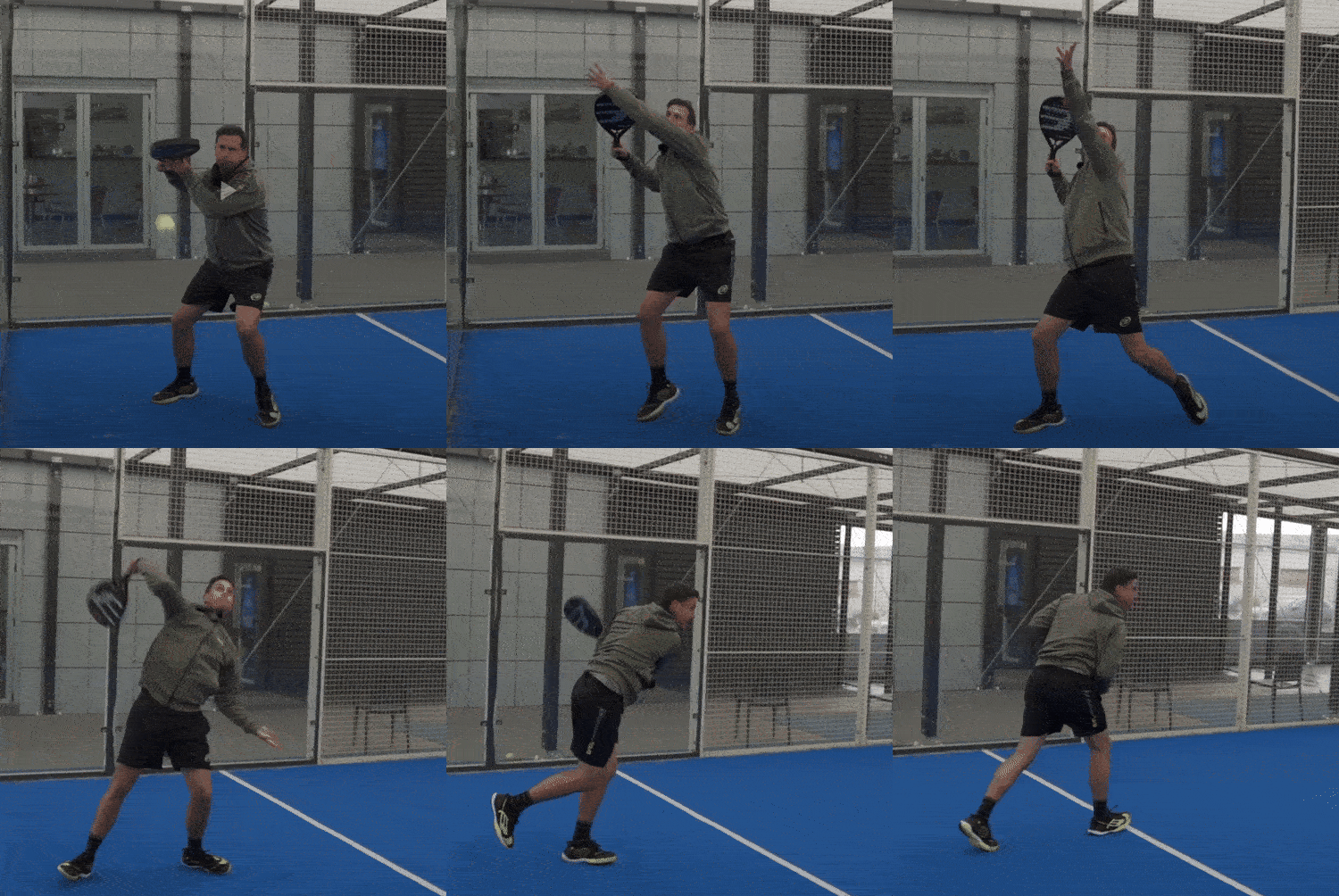
The number one mistake is waiting for the ball head-on. The position must be lateral (perpendicular to the back wall). Although some professionals can disguise the shot head-on, for the vast majority of players, lateral profiling is non-negotiable to transfer weight and direct the ball.
The golden rule: Wall – Player – Ball
To be able to attack, this spatial equation must be fulfilled: we must position ourselves between the wall and the ball. If the ball stays behind our body, we will lose the ability to attack and will have to resort to emergency defense. We must adjust our steps so that the ball is always in front of us after the bounce.
High impact point
When looking to attack, we need the trajectory to be descending. Therefore, we must seek the impact as high as possible, stretching the arm. If we let the ball drop, we lose the angle and enter the “red zone” (defense), losing the opportunity for the bajada.
Forward inertia
After the impact, we do not remain static. Just like in the víbora, the arm ends like a scarf on the other shoulder, although the trajectory we want to give the ball will also determine this. We must shift the body weight over the ball and move towards the net following the direction of the shot. This not only gives more weight to the ball but also positions us to win the net if the shot is good.
When to use it
The bajada de pared cannot be forced; it is dictated by the quality of the opponent’s lob.
- Short lob or with a lot of bounce: If the ball bounces a lot on the back glass and comes forward, staying above our head or shoulders, it’s the moment to use the bajada.
- Body position: If when reading the lob we manage to get behind the ball and our body is oriented forward, we have the green light to attack.
- Avoid it on low balls: If the opponent’s lob is very good and the ball dies on the glass (low bounce), attempting an aggressive bajada is a serious tactical error that usually ends in the net. There, it’s time to defend with a lob.
How to improve it
To perfect this shot and stop it from being just a “pass ball,” at PalaHack we recommend working on these nuances:
- Reading the parabola: You need to identify if the ball is in the ascending or descending phase after the bounce. If the ball is falling, we must anticipate and catch it before it drops too much.
- Varying speeds: You don’t always have to smash the ball. Sometimes, being offensive means playing a bajada at a lower speed but with a lot of angle to the feet of the opponent who comes up to block.
- Foot adjustment: Moving with short steps to adjust behind the ball is vital. If we arrive late or poorly positioned, the shot will lose all its effectiveness.
Tactics of the bajada de pared
The bajada is a double-edged sword if not used with tactical intelligence.
- Aim for the feet: If the opponents are at the net, the bajada should be directed at their feet to make the volley difficult and provoke an error or an easy ball.
- The Feint (Advanced Level): An excellent tactical resource is to prepare the body as if we were going to hit a lob, forcing the opponent to retreat or hesitate, and at the last moment execute a quick bajada or chiquita to the feet.
- Follow the trail: If we make a good bajada, we must move up to the net immediately to close spaces, preferably covering the direction where we have hit the ball.
Typical mistakes
In our experience analyzing players, these are the mistakes that doom the bajada:
Letting it drop too much
If we hit when the ball has already dropped below the height of the net, we are at a disadvantage and will likely leave it in the net or facilitate an easy volley.
Standing still watching
Hitting and staying at the back admiring the shot. If the bajada is good, you have to move up to press. If we stay back, we lose the advantage generated.
Lack of rotation
Trying to hit head-on or doing “the exorcist girl” (turning the body unnaturally) instead of profiling and accompanying the shot.
Not communicating
Not listening to the partner about the opponents’ position. If they are glued to the net, a powerful bajada is suicide; there, a lob would be needed.
Paquito Navarro’s cuchilla
When we talk about the ultimate expression of the bajada de pared, we talk about the “Cuchilla”, a term popularized by players like Paquito Navarro.
Technically, it is a bajada de pared executed with maximum power and aggressive slice effect. It is usually performed with the racket held high, entering the ball with violence so that it shoots out like a “missile”.
The goal of the cuchilla is not just to pass the ball, but to pierce the opponent or, if not, for the ball to be so heavy and fast that, if they manage to block it, the rebound goes to the glass. It is a high-risk, high-reward shot that requires perfect timing and a very generous wall rebound.
Who better than Paquito himself to explain the cuchilla to us? Enjoy the video!

Frequently asked questions
- Where should I direct the bajada de pared? The safest option is to aim for the center of the court or the feet of the opponent we have cross-court, as we have more margin for error due to the court’s distance.
- Can I make a flat bajada? Yes, especially if the ball is very comfortable and high. The flat shot seeks pure speed, while the sliced (cuchilla) seeks for the ball to slide upon hitting the ground or back wall.
- If the ball bounces very little on the glass, can I attack? No. If the bounce is scarce, you are in a defensive situation. You must get the racket underneath and opt for a lob or a chiquita, never try to accelerate a ball that doesn’t have height.
The bajada de pared can be considered as the thermometer of a backcourt player’s aggressiveness. Mastering it will allow you to stop being a spectator at the back of the court and become a constant threat, making you a much more unpredictable player.
PalaHack
We got the bug for this wonderful sport more than 10 years ago.
We want you to feel that, when you read one of our analyses, it is like receiving advice from those friends with whom you share the court every weekend. If something is not clear or you want to know more, do not hesitate to ask!