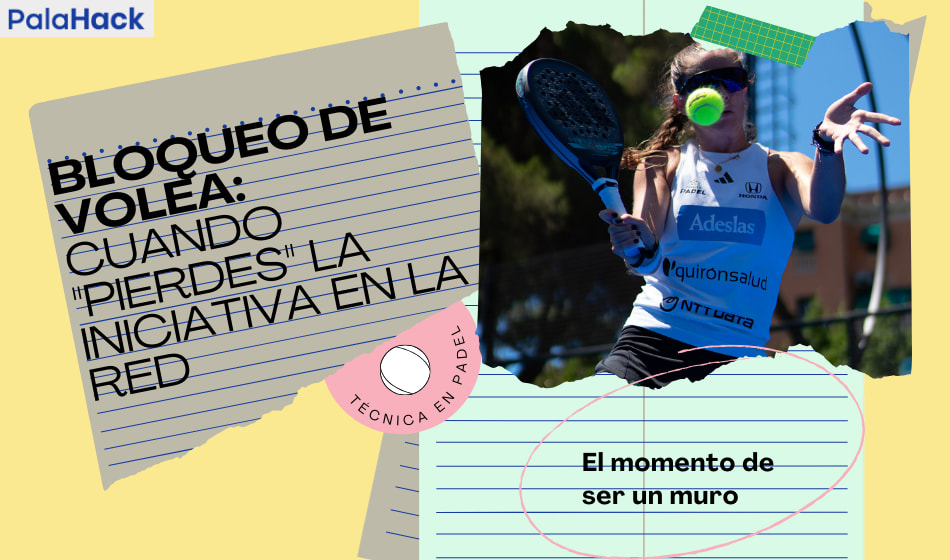
Volley Block: Your Missile Shield
28 de January de 2026 | Updated 17 de April de 2026
At PalaHack, we are tired of seeing a recurring tactical and technical error in clubs: the player who believes that being at the net always means attacking. The reality is that you also defend at the net. The block is that silent tool that distinguishes a player who “throws stones” from one who understands the game. It’s not about winning the point with a spectacular shot; it’s about surviving a missile from the opponent and maintaining the dominant position.
Today we break down the technique of the volley block, an emergency maneuver you must master for when the opponent demands speed or plays to your body.
The “Wall” Technique: Less is More
The fundamental technical key to blocking lies in the preparation or setup. When we are at the net and the ball comes fast, the number one mistake is taking the racket back. In a block, the setup must be extremely short, practically nonexistent.
The Short Setup and the Racket as a Mirror
If the ball comes fast, we don’t have time to react. We must present the face of the racket forward, as if it were a mirror, and use the ball’s own speed to return it. If you take the racket back when attacked strongly, you will be late to the impact point, and the ball will go to the back glass or the net. The movement is compact: block and slightly accompany, without wrist flicks.
Firmness vs. Wrist Action
In blocking, the wrist must be firm. We are not looking to accelerate the ball (it already comes accelerated from the opponent), we aim to redirect it. Upon impact, we must transfer the body’s weight forward so that the ball doesn’t overpower the racket, but without making a long swing.
Critical Situations: When Should We Block?
At PalaHack, we identify three scenarios where blocking is mandatory. Trying to attack in these situations often ends in an unforced error.
The “Dreaded” High Backhand Volley
This is a situation that should be forbidden in the manual of the offensive amateur player. When the opponent plays a high ball to our backhand (while at the net), many try to hit or accelerate it. Mistake. Unless you are Arturo Coello or Juan Lebrón, who have the technical physical ability to attack from there, for the rest of us mortals, that ball is defensive.
The solution: Block the ball. Don’t try to win the point. Play a slow ball to the fence or deep to the corner to complicate the opponent, but assume you are defending, not attacking.
The Missile to the Body
When the opponent plays strongly to the body (“point-blank”), there is no space to prepare the shot. Here, blocking is pure survival.
The technique: If you can’t dodge the ball (which is sometimes the best option if it’s going out), you must put the racket in front of your body and block, aiming for the opponent’s feet or an open space. If you try to accelerate a ball coming to your body, it’s most likely you’ll hit it to the side glass or leave it in the net.
The Ball Below the Tape
If they play a “chiquita” or a bajada that catches us out of position and the ball drops below net height, attacking is forbidden. By definition, if we hit from low to high, the ball will lift.
The tactic: We must block that ball seeking depth or play a slow ball (chiquita) back. If you try to press a volley from below the net, the ball will float, and you’ll gift the point to the opponent.
Comparison: Attack Volley vs. Block Volley
To make it crystal clear, we differentiate these two gestures that, although they occur in the same area of the court, are opposites:
Characteristic Attack Volley Block Volley Ball Height Above the net Low, to the body, or high uncomfortable backhand Setup Short but with follow-through Nonexistent (Racket forward) Objective Win the point or damage Neutralize and maintain the net Speed Medium-high acceleration Utilize the opponent’s speed Risk Medium (Looking to finish) Low (Looking not to fail) A concept we love to convey at PalaHack is that at the net, it’s not always about “killing” the ball. Sometimes, the mentality should be to suffocate the opponent. The block is the perfect tool for this. If the opponent throws you a strong “melon” and you block it softly to the feet or deep to the corner, you’re returning the problem. You force them to play another ball from an uncomfortable position. Often, the point is won by the opponent’s error when trying to attack again a ball that you have blocked intelligently.
The volley block is the shot that demonstrates maturity on the court. Leave the ego out: if you’re attacked strongly, keep the racket firm, shorten the setup, and use their force against them. Don’t try to be a hero by returning a missile with another missile.
Frequently Asked Questions (FAQ)
- Should I block with a slice effect? In emergency situations, like a very strong bajada de pared, sometimes it’s better to play flat. The slice effect makes the ball float more. If you block flat, the ball will go more directly to the opponent’s feet.
- Where should I direct the block if they play to my body? Ideally, try to block it towards the feet of the opponent coming up or, if you have enough composure, find the open space if one of the opponents has stayed back. But the priority is to get the ball over to the other side.
- Which racket helps me more in blocking? Rackets with a wide sweet spot and medium or low balance (round or hybrid) tend to be superior in blocking. A very head-heavy racket or one with a small sweet spot will penalize you if you don’t hit perfectly in the center when the ball comes fast. Rackets like the ML10 or the Vertex Control tend to work very well in this defensive aspect.
PalaHack
We got the bug for this wonderful sport more than 10 years ago.
We want you to feel that, when you read one of our analyses, it is like receiving advice from those friends with whom you share the court every weekend. If something is not clear or you want to know more, do not hesitate to ask!