Official Measurements and Dimensions of a Padel Court
22 de May de 2024 | Updated 17 de April de 2026
To enjoy this exciting game, it is essential to be in an environment that meets the standards and fulfills all the requirements set by the F.I.P (INTERNATIONAL PADEL FEDERATION).
Knowing these specifications is not only essential for building appropriate courts, but it will also allow you to improve your game by better understanding the characteristics of the environment where padel is played. Join us on this technical and practical journey!
Court Areas
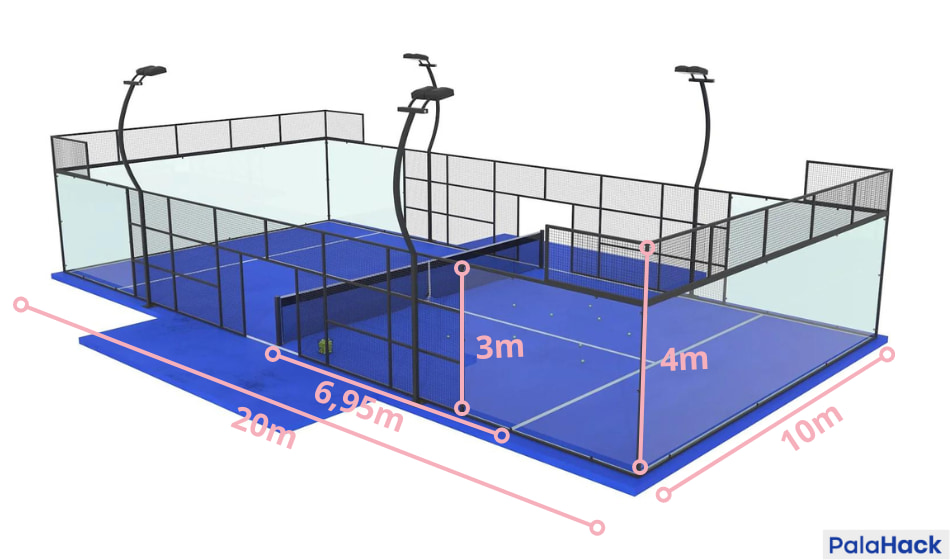
The padel court is a rectangle with dimensions of 20×10 meters (therefore covering 200 square meters), and the playing surface is divided similarly to other racket sports, but with unique features. The court is enclosed by walls and fences, which are essential in padel play.
Starting from the basics, we know that the court is divided by the net into two equal parts. Parallel to the net and on each side of the court are the service zones, marked by a line between the court’s widths. Serves must be made from behind this line in the service boxes, respecting the diagonal direction to be valid.
Characteristics of the Court Areas
- Baseline and Sidelines: Mark the outer limits of the court. The official dimensions of a padel court are 20 meters long by 10 meters wide.
- Net: Divides the court into two equal halves. The height of the net should be 88 cm at the center and 92 cm at the ends.
- Service Zones: These are marked by two lines parallel to the net and on each side of the court. These lines divide each half of the court into two squares, where players must serve.
- Back and Side Walls: In padel, the walls are an active part of the game. The back walls have a height of 3 meters, while the side walls are 3 meters high for the first 4 meters from the back, and then 2 meters high for the remaining 6 meters towards the center of the court.
- Access Doors: The court has access points on each side of the net for entering and exiting the playing area. These doors must be designed so as not to interfere with the game.
Line Thickness Measurement
The lines of the padel court must have a thickness of 5 centimeters. This thickness is standard and applies to all lines on the court, including service lines and the center line.
It is crucial that the lines are clearly visible to avoid any confusion during the game. Therefore, it is recommended that the lines be of a color that strongly contrasts with the color of the court surface. The choice of color can make a significant difference in visibility and, consequently, in the quality of the game.
Additionally, it is important that the lines are well-painted and maintained, which are things we take for granted but do not always happen.
The Net
The net has an official height of 88 cm at the ends and 92 cm at the center. This height difference is key to maintaining the tension of the net and ensuring it stays firm throughout the match.
Additionally, the net is made of a durable mesh that must withstand the constant impacts of the ball. The top of the net is finished with a white band (sometimes also including advertising elements), which must not exceed 5 cm in width, and is usually reinforced to maintain the integrity of the net during intensive use.
It is very typical for the net not to have the necessary firmness, so make sure to check it regularly.
Height of a Padel Court
The minimum height a padel court must have is 3 meters. This measurement applies to the side walls up to the last quadrant near the back wall. From there, the side walls must reach a height of 4 meters, as well as the back wall.
These heights allow players to execute a wide variety of shots without worrying about space limitations. They also facilitate the practice of movements like the smash and other high shots, which are essential at many moments in the game.
Another important point is the free height above the court, which must be at least 6 meters across its entire surface. This free height is crucial to avoid any interference with the ceiling or structural elements, which could affect the ball’s trajectory.
Enclosures: Fence and Grille
The fences and grilles comply with official measurements and specifications to ensure a uniform and safe playing experience. Below, we detail the most important characteristics:
- Height: The fences and grilles must have a minimum height of 3 meters and a maximum of 4 meters at the back of the court.
- Material: Generally, the grilles are made of galvanized steel to offer resistance and durability. The fences can be covered with plastic materials or special paint to prevent corrosion, allowing visibility and the entry of natural light, which enhances the playing experience for both players and spectators.
Exterior Zone and Safety
The exterior zone of a padel court is fundamental not only for the aesthetics and functionality of the space but also for the safety of the players. This space must be well-defined and designed to allow safe and comfortable access to the court.
It is essential that the exterior zone is free of obstacles and well-lit. Good lighting not only improves visibility during night matches but also increases safety, preventing possible accidents. Additionally, it is recommended that the floor be non-slip to prevent falls.
Measurements in Individual Padel
If there are individual courts, they have a series of special characteristics:
- Length: 20 meters
- Width: 6 meters
- Height of the walls: A minimum of 3 meters and a maximum of 4 meters.
These dimensions ensure that players have enough space to move and execute their shots accurately. Additionally, the court has a central net that divides the field into two equal parts.
Regarding the net, it is the same as on a regular court; it must have a height of 88 centimeters at the center and 92 centimeters at the ends.
Other Elements
Court Orientation
Proper orientation can enhance the players’ experience and minimize distractions. Here are some key points to consider:
- North-South Orientation: This is the most recommended orientation for padel courts. This way, the sun does not bother the players for most of the day, especially during peak sunlight hours.
- Avoid Glare: If a North-South orientation is not possible, ensure that neither end of the court is directly aligned with the sunrise or sunset. This will reduce glare and improve visibility.
- Wind Protection: Consider the predominant wind direction in the area. Use natural or artificial barriers to minimize its impact on the game.
- Artificial Lighting: If playing at night, ensure that the lighting is uniform and does not create shadows that could affect the visibility of the ball.
Lighting
The official regulations set some parameters for padel court lighting. A lighting of at least 500 lux is recommended for competition courts and 300 lux for training or recreational courts.
The most common lighting systems are LED spotlights, which offer a bright white light, ideal for night play. Additionally, LEDs are energy-efficient and have a long lifespan, making them perfect for sports facilities. Here are some practical tips for adequate lighting:
- Uniform Distribution: Ensure that the spotlights are distributed so that the entire court is evenly lit.
- Height of the Spotlights: The spotlights should be placed at a minimum height of 6 meters to avoid glare and shadows.
- Orientation: The spotlights should be directed towards the court, avoiding light dispersion towards the outside or directly into the players’ eyes.
- Maintenance: Perform regular maintenance on the spotlights to ensure they work correctly and there are no dark areas on the court.
Good lighting not only improves visibility but also reduces visual fatigue and enhances player performance.
With or Without Doors
Courts with doors are the most traditional and are designed to offer controlled access to the court. These doors are usually located on the sides and allow for quick entries and exits during the game, which can be crucial in intense matches. Additionally, doors provide greater access control to the court, which can be useful for events and tournaments.
On the other hand, courts without doors offer greater freedom of movement. This can be advantageous for more experienced players looking to make complex plays without the limitation of a door.
When considering a court without doors, it is essential to ensure that the edges of the court are well-protected to prevent accidents. The choice between a court with or without doors will depend on various factors, such as the level of the players, the type of events planned, and personal preferences.
We hope you have found all your doubts addressed here. For anything else, feel free to leave a comment.

PalaHack
We got the bug for this wonderful sport more than 10 years ago.
We want you to feel that, when you read one of our analyses, it is like receiving advice from those friends with whom you share the court every weekend. If something is not clear or you want to know more, do not hesitate to ask!