Carbon 3K, 12K or 18K: Learn Their Differences in a Padel Racket
27 de January de 2026 | Updated 17 de April de 2026
At PalaHack, we face one of the most recurring and poorly explained doubts in the padel sector daily: carbon nomenclature. Is 18K harder than 3K? What does 12K really bring to my game? There is a huge confusion generated partly by brand marketing and partly by the lack of rigorous technical information.
Today we are going to dissect carbon fiber with the precision of an engineer, based on our experience testing hundreds of rackets and the technical knowledge shared by experts like Manu Martín, so you finally understand what you have in your hands.
What does the “K” really mean?
To understand the behavior of a racket, we must first understand the unit of measurement. The “K” refers to the number of filaments that make up each carbon thread used to weave the surface of the racket.
- 3K: 3,000 filaments per thread.
- 12K: 12,000 filaments per thread.
- 18K: 18,000 filaments per thread.
- 24K: 24,000 filaments per thread.
Visually, this translates into the size of the grid or “checkerboard” we see on the racket’s face. A 3K carbon presents very small squares, while an 18K shows much larger and wider squares, like those seen on the Nox AT10 18K2. But what does this imply in the game? This is where physics comes in.
The Great Myth of Hardness: Is 18K harder?
This is where most players (and many stores) get it wrong. Mathematical logic leads us to think that “more is better” or “more is harder,” believing that an 18K or 24K racket will be harder than a 3K. At PalaHack, we confirm that this is incorrect in most cases of padel racket construction.
According to our experience and verified technical information, carbon with fewer K (like 1K or 3K) usually provides greater rigidity, while carbons with more K (12K, 18K, 24K) tend to be more flexible or elastic.
The Technical Explanation: Surface Tension and Weaving
To understand it, let’s use an analogy we’ve verified: shoelaces. Where the knot is made, the material is more tense and hard. In a racket, 3K carbon has many more crossings or “knots” per square centimeter because its threads are finer. This generates a greater surface tension, resulting in a drier and stiffer feel.
On the other hand, an 18K or 24K carbon, having wider and flatter threads, has fewer crossings on the same surface. This allows the fiber to flex more when hitting the ball, offering a more elastic behavior.
Detailed Analysis by Fiber Type
We break down the on-court behavior of each fiber based on our tests:
1K and 3K Carbon: Extreme Rigidity
When we test rackets like the Siux Pegasus 1K Limited Edition6 or the Babolat Counter Viper (which uses 3K), the feeling is of hardness.
- Behavior: These are fibers that offer little ball output at low speed (you have to push the ball) but enormous power in strong smashes because they do not absorb energy.
- Demand: The sweet spot is usually reduced. In the Pegasus 1K, we noticed that if you don’t hit the exact center, the ball doesn’t come out as you want. It’s a dry feel, ideal for technical players. Babolat, for example, uses 3K in its Counter Viper model to compensate for the balance and give it extra rigidity.
12K Carbon: The Balance Point
The 12K is considered the standard of versatility in the current market. It is positioned midway between the rigidity of 3K and the elasticity of 18K.
- Behavior: It is the carbon chosen for bestsellers like the Bullpadel Vertex 03 or the Babolat Technical Viper. It offers an excellent compromise: enough rigidity to define points and enough flexibility not to feel like hitting with a wooden board.
- Our opinion: If you don’t know what to choose, 12K is usually the safest option due to its balance, as decided in many versatile rackets, where 12K is chosen for its versatility to perform well both in winter and summer.
18K and 24K Carbon: Elasticity and Feel
Present in iconic rackets like the Nox AT10 Luxury Genius 18K by Agustín Tapia.
- Behavior: Being wider fibers, they tend to be more flexible. This can provide a more comfortable feel and greater ball output from the back of the court, helping with lobs and defense. However, to achieve a “competition” feel with these carbons, brands often combine them with harder or high-density rubbers to compensate for that face flexibility.
The Complete Equation: It’s not just the Carbon
We want to be very transparent: carbon alone does not define the hardness of the racket. It’s a mistake to judge a racket just by whether it is 12K or 18K. The final hardness depends on the combination of three critical factors:
The Rubber (The Core)
It is the determining factor. You can have a 3K carbon (rigid) with an ultra-soft rubber (Soft), and the racket will feel soft. Or an 18K carbon (elastic) with a very hard rubber, and the racket will be like a rock.
The Mold
The shape of the racket and the tension generated by the mold influence. The same material in a diamond mold feels different than in a round one due to the surface tension of the face.
The Resin (Epoxy)
It is the “glue” that binds the fibers. The quality and density of the resin also affect the final rigidity of the plane.
Temperature Influence: The Invisible Factor
A technical aspect often overlooked is how climate affects these fibers.
- Heat: The rubber expands and the materials soften. An 18K racket in summer can feel excessively “gummy” if it doesn’t have a rubber to compensate.
- Cold: The materials contract and harden. A 1K or 3K carbon in winter can feel extremely hard, almost like playing with a pan, transmitting more vibrations if you don’t have the right technique.
Conclusion
Which carbon is better? There is no “best,” only what is right for your game:
- Choose 1K or 3K if you are a technical player, looking for a dry feel, maximum precision, and have the strength to move the ball from the back.
- Choose 12K if you are looking for the perfect balance. It’s the all-rounder that works well in attack and defense.
- Choose 18K or 24K if you are looking for a slightly more elastic feel (always depending on the rubber) and extra help in ball output, or if you like to feel the ball enter more into the racket.
Don’t be guided only by the number. We always recommend testing the racket, as the complete “recipe” (carbon + rubber + mold) is what defines the real on-court experience.
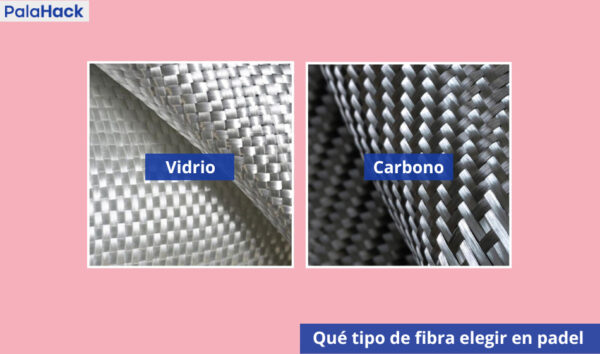
If you’re interested in this topic, don’t miss this article on the differences between fiberglass and carbon fiber:
Frequently Asked Questions
- Is the 12K racket harder than the 18K? Generally yes, in terms of the rigidity of the fiber itself. The 12K has more thread crossings than the 18K, giving it a slightly stiffer feel, although the internal rubber can change this perception.
- Why do professional players change carbon in summer and winter? Because temperature alters hardness. Some players use harder rackets in summer (because the heat softens the materials) and softer versions in winter.
- Is 24K carbon of better quality than 3K? No. The quality of the carbon is the same. The difference lies in the weight and the number of filaments, which give different mechanical properties (rigidity/flexibility), not better or worse.
PalaHack
We got the bug for this wonderful sport more than 10 years ago.
We want you to feel that, when you read one of our analyses, it is like receiving advice from those friends with whom you share the court every weekend. If something is not clear or you want to know more, do not hesitate to ask!