Serve and Return Rules in Padel
24 de January de 2026 | Updated 17 de April de 2026
Knowing the rules of the serve will not only help you avoid common mistakes, but also allow you to make the most of this opportunity to start each point with an advantage.
We are going to review all the official regulations, the most effective types of serve based on these, and the most frequent errors you should avoid.
Whether or not you are an experienced player, this interests you since from 2026 we have changes in the regulations that we should all know.
How to Serve Correctly
The serve in padel is one of the most important shots in the game, as it is the only moment when you have total control over the ball before the point begins.
Initial Position
Before serving, position yourself behind the service line with your feet shoulder-width apart. The racket should be held with a continental grip, which will allow you greater control and versatility in the shot.
Preparation
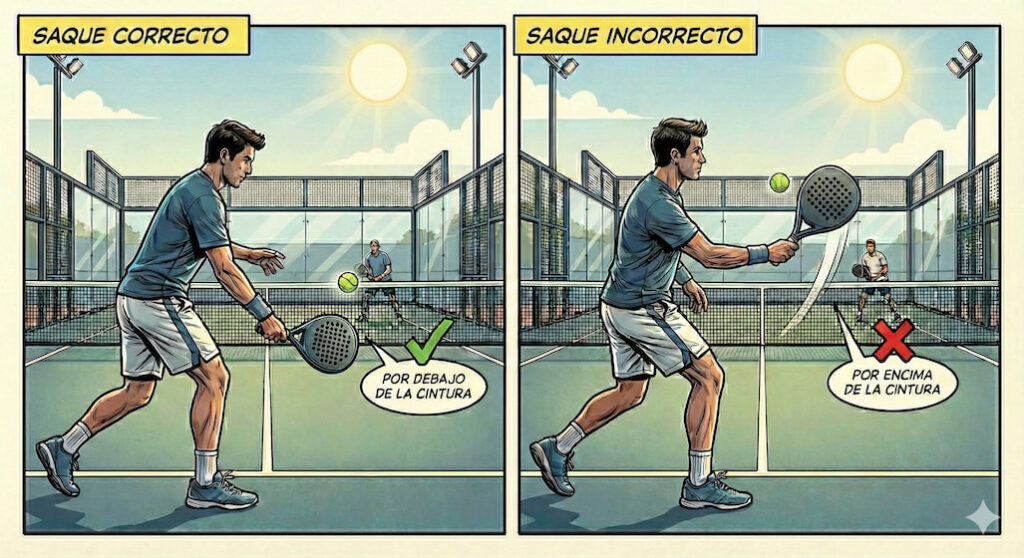
The serve must be performed from below. Hold the ball with your non-dominant hand and let it drop down, without throwing it. The racket should come from above to below (it will help you to notice that in the preparation the elbow comes from above initially and is not close to the body), ready to hit the ball when it is at hip height.
Impact
Hit the ball when it is at waist height as this is the maximum allowed height, meaning that it should never exceed your waist otherwise it will be a fault, but at the same time it is essential to take advantage of the limit to make the most of it, keeping the racket at an appropriate angle to give the desired effect. It is important that the impact is clean and controlled to avoid unforced errors.
Direction and Effect
A good serve is characterized by its direction and effect. You can opt for a slice serve that will make the ball bounce low and move quickly towards the side wall, complicating the opponent’s return. Alternatively, a flat serve can be effective to surprise the opponent and make the ball bounce a lot off the glass.
Post-Serve Movement
After serving, quickly move towards the net to take an offensive position. This movement should be fluid and natural so that you can be ready to volley the opponent’s return.

Make the Most of the Rules
- Vary your serves: Do not always serve in the same way or in the same direction. Vary between slice, flat serves, and different effects to keep the opponent guessing.
- Constant practice: Dedicate time to practicing your serve in different game situations. Consistency and precision in the serve are achieved with repetition and practice.
- Communication with your partner: Inform your partner of the direction and type of serve you are going to make so they can prepare and cover the best possible area.
Remember that the serve is the start of each point and can make a difference in the development of the game. Practice these steps and tips to improve your serve and start each point with a strategic advantage.
When is a Serve Fault
The serve is the first shot that starts each point in padel, and although it seems simple, the rules governing it are specific. Knowing when a serve is a fault will allow you to avoid common mistakes and improve your game.
A serve fault can occur for various reasons. Here we explain the main ones:
- Height of the hit: The ball must be hit below the waist. If the serve is performed above this height, it is considered a fault.
- Foot position: During the serve, the player must not step on or cross the service line. Both feet must be behind the line until the ball is hit.
- Improper bounce: The ball must first bounce in the diagonally opposite service box. If it touches any other part of the court, it is a fault.
- Lack of contact: If the player attempts to hit the ball and misses, without the ball touching the racket, it is considered a fault.
- Two failed serves: If a player commits a fault in both serve attempts, the point is awarded to the opponent.
- The ball touches the fence: If when serving, the ball touches the net and falls outside the service box, it is a fault. However, if the ball touches the net and falls within the correct service box, the serve is repeated.
- External interference: Any external interruption affecting the serve, such as a ball entering the court from another match, is considered a fault and the serve is repeated.
With these points in mind, you can avoid committing faults during the serve and ensure your game is smoother and more effective, many times it is better to ensure a good first serve and not commit a fault so as not to have to make a second serve where you might send a very “easy” ball. Remember that the serve may not be the most decisive shot in padel, but starting each point correctly will give you an important initial advantage.
Update 2026!
The FIP (International Padel Federation) has made updates to the regulations for 2026 and among them are things that affect the serve.
The main change in the serve refers to the fact that the regulation now explicitly prohibits hitting the ball within the projection of the box or laterally.
If you want to know more, don’t miss this article we have prepared:
How Many Times a Fault Can Be Committed
The answer is simple: during each serving turn, the player is entitled to commit a fault without losing the point. This means that if the first serve does not comply with the rules, the player has a second opportunity to correct it.
The Importance of the “LET”
Important! If the ball touches the net and enters the correct service box (known as a let), the serve is repeated and does not count as a fault. This can occur infinitely consecutively. The player retains the number of attempts they had before that serve, if the let is on the first it will be two, or one attempt if it is on the second.
How Many Times the Ball Can Bounce on the Serve
If the ball bounces twice in the receiver’s court during a padel serve, it means that the serve is valid and the point is won by the serving pair. Unlike in-play, where two bounces mean losing the point, in the serve the “double bounce” within the regulatory box ends the point in favor of the server.
What Cannot Be Done in the Serve
The serve in padel is a crucial element that can make a difference in the development of a match. However, there are certain rules that we must follow for the service to be considered valid. Here we detail what cannot be done in the serve:
- Throw the ball above the waist: When serving, the ball must be hit below the player’s waist. Raising it too high can result in an invalid serve.
- Step on the service line: Before hitting the ball, the server cannot step on or cross the service line. It is essential to keep both feet behind the line until the ball has been hit.
- Hit the ball in the air: The ball must bounce on the ground before being hit. Hitting it without allowing it to bounce first constitutes a fault.
- Serve outside the service box: The ball must fall within the diagonally opposite service box from where the serve is made. If the ball falls outside this box, the serve will be considered null.
- Make excessive movements: The server must maintain a stable posture and not make excessive movements that may distract the opponent. Only a small step forward is allowed to improve the hit.
Rules for the Receiver
The Mandatory Bounce
It seems obvious, but under no circumstances can you hit the serve ball before it bounces.
- Volleying is prohibited: If you hit the ball in the air (even if you are outside the box), you automatically lose the point.
- The second bounce: You must hit the ball after the first bounce and before the second. If the ball bounces twice, it is a point for the server.
When is it “Bad” After the Bounce?
This is the source of all discussions. The regulation is very clear about what the ball can touch after bouncing in your box:
- Glass/Wall: If the ball bounces in your box and then touches the back or side wall (or both), the serve is VALID and you must return it.
- The Metal Mesh: If the ball bounces in your box and then touches the metal mesh, it is a FAULT of the server. Exception: If the ball bounces in the box, touches the mesh and then the ground, it is still a fault. Contact with the mesh after the bounce in the serve is illegal.
Position on the Court
- The Receiver: You can position yourself anywhere in your field (inside or outside the box), as long as it is not in the partner’s field. It is common to position yourself a step behind the service line and near the side wall.
- The Receiver’s Partner: Can position themselves in any part of their own field. They can be at the net, at the back, or even “glued” to the receiver (although strategically it would be a disaster).
The Order of Reception
- At the beginning of each set: The receiving pair decides who will receive the first point (right side) and who the second (left side).
- During the set: Once the order is chosen, it cannot be changed until the set is over.
- Error in order: If you realize that you are receiving on the wrong side, you must finish the game in that position and resume the correct order in the next game where you have to receive.
| Situation after the serve | Is it valid? | Result |
| Touches the net and bounces in the box | LET | The serve is repeated |
| Bounces in the box and touches the mesh | NO | Server’s fault |
| Bounces in the box and touches the glass | YES | The point must be played |
| Volley the serve in the air | NO | Point for the server |
The return is the defensive response that seeks to recover the net.
Positioning: Position yourself between the baseline and the service box line. Keep your knees bent and perform a split step (small activation jump) just as the server impacts the ball.
Return Tactics:
- The Lob: The best option to displace the servers from the net and take the offensive position yourself, it is a very good option if the serve is very weak and you have absolute control.
- Return to the center: Reduces the opponent’s angles and usually creates doubts between the pair moving up.
- Return to the feet: Forces the server to make a very complicated “low volley” while moving up.
When preparing to receive the serve, you should position yourself halfway between the white line of the service box and the back wall. This will allow you to intercept some serves before they hit the side wall, moving towards the ball without neglecting the possibility of being served to the middle of the court.
Bonus: Tie Break Which Side to Serve and Who Serves After the Tie Break
First, it is important to highlight that in a tie break the serve alternates every two points. The player who serves the first point of the tie break does so from the right side of the court, also known as the “even” side. The next serve, corresponding to the second point, is made from the left side of the court, the “odd” side.
To make it clearer, here is a simple scheme:
- First point: Serve from the right side (even).
- Second point: Serve from the left side (odd).
- Third point: Change of server and serve from the right side (even).
- Fourth point: Serve from the left side (odd).
This pattern repeats until a player or pair reaches seven points, always with a minimum difference of two points.
Now, who serves after the tie break? The serve for the next set is performed by the team that did not serve the first point of the tie break. This ensures a fair and equitable alternation in service. If your team started serving in the tie break, it will be the turn of the opposing team to start the next set. This detail can be crucial to maintaining strategy and game rhythm.
Thank you for joining us on this journey through the rules of the serve in padel. See you on the court!

PalaHack
We got the bug for this wonderful sport more than 10 years ago.
We want you to feel that, when you read one of our analyses, it is like receiving advice from those friends with whom you share the court every weekend. If something is not clear or you want to know more, do not hesitate to ask!