-49%
8.55

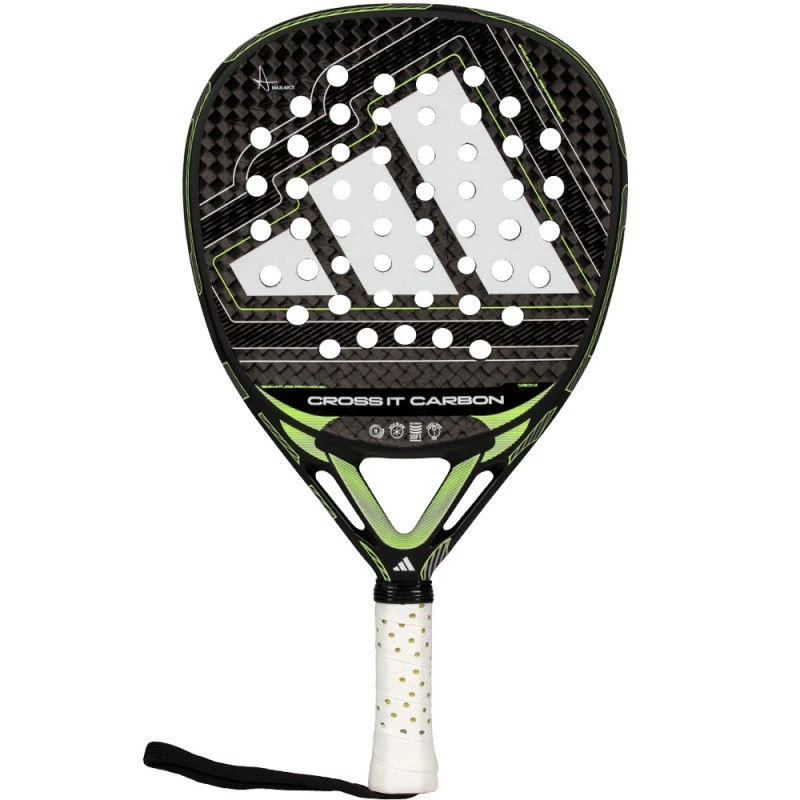
Adidas Cross It Carbon 2026
This padel racket Adidas diamond is an ideal model for a level intermediate and stands out for Ball Output.
R.R.P 280,00 €
Price
143,59 €
Compare racketThis padel racket Adidas diamond is an ideal model for a level intermediate and stands out for Ball Output.
R.R.P 280,00 €
Price
143,59 €
Compare racketThe Adidas Cross It Carbon 2026 fully enters the realm of paddles designed for offensive players, with a diamond shape, high sweet spot, and a construction of 6K carbon with EVA Soft Performance foam that aims to blend power and comfort. On the court, the Dynamic Airflow technology is truly noticeable in the speed of movement, as the open hole system in the heart makes the paddle feel more aerodynamic with each acceleration. This is not a gentle option nor a model for beginners, but rather a tool aimed at a vertical and dominant game. Additionally, it is the paddle used by Maxi Arce, which fits well with the type of player it is aimed at: someone who wants to take charge when they step to the net.
The first thing we noticed when stepping onto the court with this version is a feeling of a fast paddle in the air, more aerodynamic than its diamond shape might initially suggest. The Dynamic Airflow technology plays a significant role here, as the arrangement of open holes in the heart helps to move it faster and accelerate the stroke better. That first impression is accompanied by a very clear high balance, with weight loaded in the head, so from minute one it shows that it is more designed for attacking than for surviving in defense. It is not a neutral paddle nor does it aim to be.
In terms of touch, we find a medium touch with a slight tendency to firm, with a lively response and a fairly dry sensation upon impact, although it does not feel excessively hard thanks to the EVA Soft Performance foam. The ball exit is high when we apply pressure, especially at medium and high speeds, and this is where this Adidas truly shows its character. The 6K carbon faces and the carbon fiber frame give it a solid, consistent structure, with a rigidity in the plane that favors offensive strikes. This is complemented by the 3D relief finish and rough surface, which indeed has a real influence in play when we seek grip and spin.
From the back, it left us with a fairly clear feeling: it has control, but it needs to be worked on. For a diamond paddle, it performs well in defense, although it does not give as much as a round paddle and requires us to accompany the ball for the shot to come out clean and deep. The medium touch and EVA Soft Performance foam help a lot with lifted lobs and wall exits with a more technical touch, especially when we are well positioned. If we do our legwork well, the ball comes out with intention, and we can transition from defense to attack without the point feeling eternal.
However, when we arrive late or hit poorly supported, the high balance becomes quite noticeable. Here we need a firm arm to block and lift heavy balls, as it is not the fastest paddle when close to the glass or in sudden direction changes. At medium-speed shots, it allows for reasonable ball direction, but demands more attention than a more gentle model or one with a medium balance. This demand is part of its personality and also defines who it will truly fit.
What surprised us most in this area of the court was the ball exit on accelerated shots. When we finish the stroke well, the response is very lively, and the ball travels with depth and weight, something that is very noticeable in those transition balls where we seek to relieve pressure and regain initiative. Even in lobs with a lifted touch, there is a noticeable extra grip thanks to the rough surface, which helps to give height and distance when executed well. It is a paddle that does not simplify the work from the back, but it rewards the player with technique and good legs.
With the 6K carbon on the faces and that head weight, the Cross It Carbon 2026 shows its best version when we step to the net. Pressure volleys come out with much weight and a tense trajectory, forcing the opponent to block uncomfortably if they fall short. When we enter decisively, we can clearly feel how the head of the paddle pulls and aids in acceleration, which greatly favors aggressive play up front. Here we quickly understood that it is a paddle designed to dominate rather than to hold back.
In trays and viboras, it moves very well for its shape, as it allows us to generate speed without having to force too much and work angles quite easily. The rough surface with 3D relief provides a good grip on the ball, which is especially noticeable in viboras, cut shots, and volleys aimed at lowering the ball or taking it out of the opponent’s comfort zone. In quick exchanges near the net, it responds well in hand and does not feel slow, which is important in a paddle with a high balance. It is clearly the area where we get the most out of it.
On the smash is where the high balance and the rigidity of the 6K carbon align best with the proposal of this paddle. The flat smash comes out strong, direct, and with weight, and the EVA Soft Performance foam provides a lively response that means we do not need an exaggeratedly long stroke to accelerate the ball. With a medium stroke, we already achieve good ball exit, although to really maximize it, we need technique and to properly set up the arm. In lifted smashes, the rough surface helps the ball bite more and rise after the bounce, making the 3rd shot accessible for those who hit well above the shoulder; even the 4th shot exits fit within that offensive profile it is aimed at.
The overall feeling it left us with is that of a paddle that combines power and control very well within what can be expected from a diamond shape. The ball exit is lively and responds with great force when we accelerate the arm, especially in offensive volleys and smashes, where the high balance and 6K carbon truly push. At the same time, the control is reasonable for this mold, but not automatic: one must have technique, hit the ball well, and work the shot to avoid errors. Where it performs best is in an offensive, vertical, and dominant game, with good arm setup and active legs to get well positioned.
Its sweet spot is high, which is entirely logical in a diamond paddle with this offensive orientation. When we hit centered, the shot comes out clean and direct, but outside the sweet spot, it quickly warns of power loss and much less forgiveness.
The manageability felt correct for the type of paddle it is, although in this aspect its attacking character is very noticeable. It is not the fastest in defense or in sudden changes, as the high balance penalizes when we have to react late or very close to the glass. On the plus side, it has the extra power grip of greater length and the adjustable cord, which improves grip on the wrist and helps hold it better during strong shots.
Its official retail price is €280, although at the time of writing this review, we found it for €229.6 in specialized stores. In terms of price, it falls into the advanced range, and in terms of materials and technologies, it fits well there: 6K carbon, carbon fiber frame, EVA Soft Performance foam, rough surface, and Dynamic Airflow are serious arguments for a demanding player. In this segment, real performance in attack and solid construction are precisely what is expected, and this Adidas delivers if our level supports it. As is often the case, with the progression of the season, these models tend to drop further, and when the next version appears, last year’s paddles often become one of the smartest purchases in terms of quality/price.
We see it as a very clear option for intermediate to advanced players who base their game on aggressiveness at the net and hitting above the shoulder. If we are looking for a paddle to play vertically, attack decisively, feel a lively ball exit, and take advantage of smashes, trays, and pressure volleys, this version makes a lot of sense. It also fits well with players who have good technique and leg work, as that is when it performs best. If we are just starting out or prefer a gentle, lightweight paddle that helps more in defense than in power, we would not go this route.
The Adidas Cross It Carbon 2026 seems to us to be a paddle with a very marked identity: offensive, lively, and demanding. Where it works best is up front, pressing at the net and smashing with intention, while from the back it requires more technical work than other more forgiving models. If our game is headed in that direction and we want a diamond paddle with good ball exit, achieved aerodynamics, and plenty of weight in the shot, it is a very serious option. If what we seek is pure ease, it is better to look towards something less aggressive.
Our recommender helps you choose the racket that best suits you, your child, or your friend to give them the best gift.