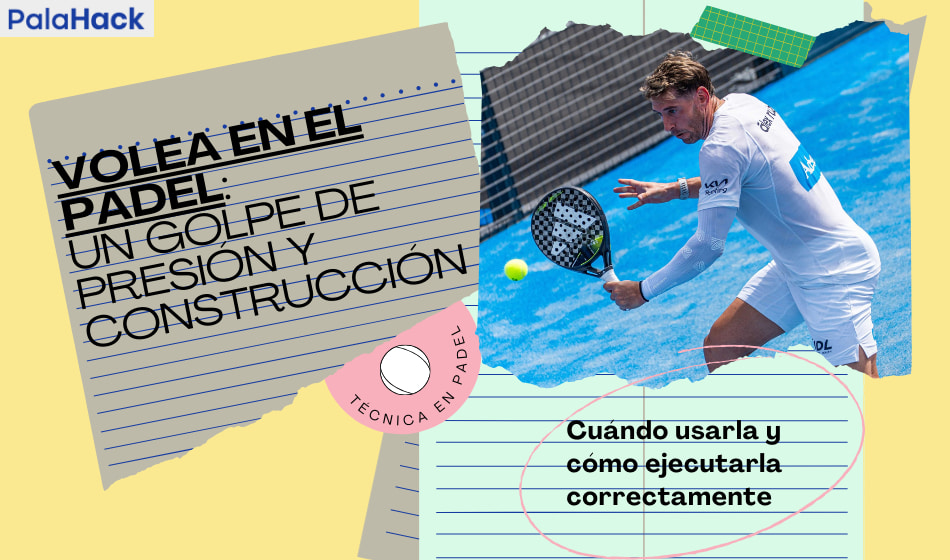
The Volley in Padel: When to Use It and How to Execute It Correctly
26 de January de 2026 | Updated 17 de April de 2026
You already know that padel is a sport where our main goal is to conquer the net, and the volley is the “toll” we must charge to stay there. Often, the amateur player confuses the volley with a pure finishing shot, when in reality, in modern padel, it is a shot of pressure and construction.
What is the volley
The volley is an aerial shot executed near the net without letting the ball bounce. Unlike tennis, where a direct “winner” is often sought, in padel, the volley has a tactical suffocation function.
At PalaHack, we like to define it as a tool for managing time and space: we aim to take time away from the opponent and reduce their spaces. It’s not always about “killing” the point, but about pressuring the opponent, forcing them to play low and with difficulty until they give us an easy ball to finish. If we try to win every point with the first volley, we will end up giving away easy rebounds on the back glass.
Types of volley
The volley is an ecosystem in itself; a technical chameleon that must adapt in milliseconds to the speed, height, and direction of the ball sent by the opponent.
We will review each one with the utmost technical rigor, explaining not only how to execute them but the tactical intention behind each one so you can dominate the net like a pro.
By Tactical Intention
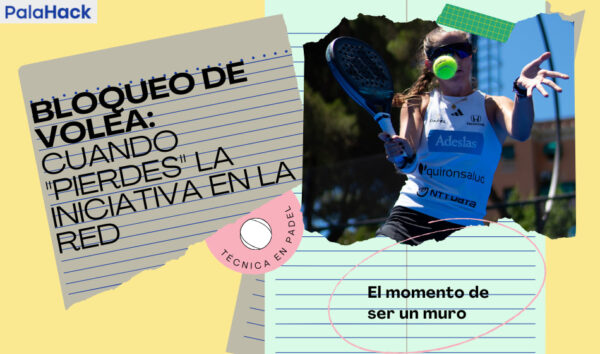
Block Volley
This is the volley we execute when the opponent speeds up the ball, for example, after a “cuchilla” or a powerful bajada de pared. Here there is no preparation; the reaction time is zero.
- Execution: Our priority is to place the racket firmly in front of the body, using the incoming ball’s own speed to return it. If we try to prepare the arm backward, we will hit late, and the ball will go to the side glass or we will leave it in the net.
- Objective: Simply pass the ball to the other side and maintain the position at the net, often aiming for the center of the court to reduce angles.
Control Volley
It is the most frequent volley in high-level padel. We do not seek to win the point directly, but to “suffocate” the opponent, moving them and forcing them to play low.
- Execution: We use a short preparation and medium speed. The key here is depth; we aim for the corners or the opponent’s feet so they cannot prepare a comfortable lob or counterattack.
- Objective: It’s not about closing the point, but working it until the opponent gives an easy ball.
Finishing Volley
We only execute it when we receive a “gifted ball”: high, slow, and close to the net (Green Zone).
- Execution: Here we do apply an aggressive weight transfer forward and accelerate the arm.
- Objective: We aim to finish the point, either by taking it out by four, bringing it to our side, or finding an unreachable angle or letting it die on the glass.
By Impact Height
High Volley
When the ball comes above the height of the net, we have license to attack.
- Execution: Having height, we can apply an aggressive slice effect (from top to bottom) so that the ball, upon hitting the back glass, drops and dies (“el moco”).
- Exception: The high backhand volley is tricky. Unless you have the power of Arturo Coello or Juan Lebrón, trying to finish with a high backhand volley is usually a mistake; it’s tactically smarter to play it deep and placed.
Low Volley
If the ball comes to the feet or very low, it is physically impossible to attack without risking leaving it in the net or sending it to the glass.
- Critical error: Trying to slice a low volley. If we apply a slice effect to a ball that is already low, the ball tends to float and rise, giving the opponent a smash.
- Solution: We must bend the knees a lot, approach the ball from below, and play it flat or with a slight topspin to make it drop at the opponent’s feet or aim for a chiquita. The goal is simply to lift it just enough to clear the net.
By Technical Execution
Forehand Volley
It is usually the shot where players feel most comfortable pressing.
- Technical detail: It is vital that the elbow is not excessively close to the body to have freedom of movement, but not so far that we lose control. The face of the racket should be presented open (“mirror”), avoiding the common mistake of excessive wrist movement, which disrupts direction.
Backhand Volley
Mechanically, it requires greater shoulder rotation. For many players, it is a more natural volley to block balls that go to the body.
- The preparation: The non-dominant hand plays a crucial role here. It should accompany the racket backward in the preparation (holding it by the neck) to ensure we rotate the shoulders and generate the necessary tension for the shot.
Slice Volley
It is the “King” of effects in padel. We aim for the ball to spin in the opposite direction so that, upon bouncing on the back glass, it tends to fall towards the ground.
- How to improve it: The approach to the ball should be from top to bottom. Imagine we want to “comb” the ball. However, as we mentioned in the low volley, you need to know when not to use it. If the court is wet or damp, the slice effect loses effectiveness, and the ball may slip upwards on the racket, so in those conditions, it’s better to play flat.
Step-by-step of the volley in padel
For good technical execution that minimizes unforced errors, we follow this biomechanical sequence that will lead us to succeed many more times:
The Grip
The starting point is immovable: continental grip (as if we were hammering a nail with a hammer).
- Why: This grip allows us to hit both forehand and backhand without losing time changing the grip, something vital at the net where reaction time is minimal. It also facilitates applying that natural slice effect we seek so the ball doesn’t lift.
- Detail: We must hold the racket firmly by the handle, avoiding the common mistake of raising the hand towards the neck of the racket, which would reduce leverage and reach.
Ready Position and the “Split Step”
Before the ball arrives, the racket should be high, at chest height, ready to react.
- The Split Step (The active pause): Just when the opponent is about to hit the ball, we must make a small stop or reading jump. If we don’t stop (“split”), we will be caught off guard or in motion, which destroys the precision of the shot.
Unit Turn: The shoulders are the engine
Here lies the secret of power without long preparation. We don’t take the arm back; we rotate the shoulders.
- Forehand Volley: We make a compact shoulder turn showing the left shoulder (for right-handers) to the ball. The racket should not go beyond the line of the right shoulder backward.
- Backhand Volley: The shoulder turn is even more pronounced. The non-dominant hand plays a crucial role here: it should hold the neck of the racket during the turn to ensure that shoulders and racket move as a block, generating tension in the torso. Upon impact, the non-dominant hand releases backward to act as a counterbalance and maintain balance.
“Short Preparation”
In the volley there is no wide backswing. The preparation must be very short, presenting the racket face open towards the ball, as if it were a mirror.
- The mistake to avoid: If we take the racket behind the head or body, we will be late to the impact point. The power is generated by the weight transfer of the body, not by the inertia of the arm from behind.
Weight Transfer and Impact Point
The hit is executed by transferring the weight of the body towards the ball through the legs, not just with the arm.
- The step forward: At the moment of impact, we must take a step with the opposite leg to the executing arm (left foot for forehand volley in right-handers). This step should be towards the ball, shifting the weight onto it so that the ball gains “weight” and depth.
- Impact point: Always in front of the body. If we impact at body height or behind, we will lose control and the ability to direct the ball to the corners.
Finish
After the impact, the racket should follow the trajectory of the ball towards the desired target, finishing the gesture long forward. We should not cross the arm excessively fast; we seek depth and penetration in the opponent’s court.
Additional Tips
- Bend your knees: Always keep your legs slightly bent to move with agility.
- Keep the wrist firm: A firm wrist will give you greater control and precision in the volley.
- Constant practice: Repetition is key. Practice this movement until it becomes a natural reflex.
Tactics in the volley
The volley is not hit anywhere. The direction and speed depend on our position, the opponent’s position, and the dynamics of the match.
Covering spaces
If the ball comes from the cross-court, we (who are at the net) must cover the center. If the ball comes from the parallel, we must stick closer to the fence to cover the line; this also serves as a consideration when we go to press, if those spaces are left open, we must take advantage of them.
Depth management
We don’t always have to aim for the back. If the opponent is at the back, a deep and fast volley can create a big rebound that makes it easy for them to return. Sometimes, a slower volley to the feet or the fence is much more damaging.
How to crush the volley
This is something all players want to do when we are at the net, trying to make the ball come out very low just after touching the carpet and fall upon bouncing on the wall and remain well buried, and for this, we must consider the following technical aspects.
- Hit with the racket face slightly open (don’t overdo it, or you’ll lose a lot of precision) and hit from the middle of the ball downwards.
- Pull the racket forward.
- The bounce must be as deep as possible (without risking too much to avoid missing the point) to bury the ball there and prevent it from rising.
The first volley
The first volley (the one we make right after serving and moving up) is, statistically, one of the most important of the point.
The common mistake is to rush forward. The secret is to perform the Split Step (stop). Just before the opponent hits the return, we must stop. It doesn’t matter if we haven’t reached the net; it’s preferable to volley from the transition zone while standing and balanced than to volley on the run and miss or leave it easy. Also, we recommend serving a bit slower to have time to reach a good net position.
Typical mistakes
- Excessive preparation (Taking the racket back): This causes us to be late to the impact and the ball to go to the glass or the net.
- Not making the pause (Split Step): Volleying while running forward makes us lose control and leaves us poorly positioned for the next ball.
- Holding the racket incorrectly: Holding the racket by the neck or too high reduces maneuverability. It should be held correctly by the handle.
- Excessive wrist movement: Trying to generate power by breaking the wrist usually ends with the ball on the back glass.
- Volleying balls that are going out: Anxiety makes us volley balls that, if we let them pass, would go directly to the glass.
Tips to improve the volley
- Train “Chiqui-padel”: Play in the transition zone or mini-tennis seeking control and short preparation before moving to the back of the court.
- Non-dominant hand: Use it to balance or even, in the backhand volley, to assist in preparation by taking it back to generate torsion.
- Set the target: Don’t look for the “winner” on the first volley. Your goal is to force the opponent to play an uncomfortable ball. Think “suffocate,” not “kill.”
Frequently Asked Questions
- What grip should I use? The continental grip (hammer) is the standard and most versatile for the volley, as it allows hitting forehand and backhand without changing the grip and facilitates the slice effect.
- Should I get very close to the net? Not necessarily. If you get too close, you are vulnerable to the lob. The ideal position varies, but generally, it’s a step behind where you could touch the net with the racket, adjusting according to the depth of the opponent’s ball.
- Why does my volley stay in the net? It is usually for two reasons: either the preparation is too wide and you hit the ball descending, or you are not bending your legs and try to lift the ball only with the wrist.
At PalaHack, we believe that a good volley is not measured by speed, but by the discomfort it generates in the opponent. Master the short preparation and the feet, and the net will be yours.

PalaHack
We got the bug for this wonderful sport more than 10 years ago.
We want you to feel that, when you read one of our analyses, it is like receiving advice from those friends with whom you share the court every weekend. If something is not clear or you want to know more, do not hesitate to ask!