Padel or Pickleball? Why Padel Remains King
30 de January de 2026 | Updated 16 de April de 2026
Hello everyone, padel enthusiasts! What a mess we have here! Lately, we keep receiving your messages, asking us the same thing: “What’s going on with Pickleball? Is it true that it’s coming to take over padel courts? Should I try it?”.
Today we’re going to roll up our sleeves. We’re going to analyze, with the same scrutiny we use to test a 400-euro racket or analyze a Paquito Navarro viper, what’s happening in this “racket war.” It’s not just about hitting the ball; it’s about materials, biomechanics, and, above all, feelings on the court.
If you’re a sports geek like us, stay until the end of the article, because we’re going to break down why these two sports seem like cousins but, in reality, live on different planets. Let’s get to it, team!
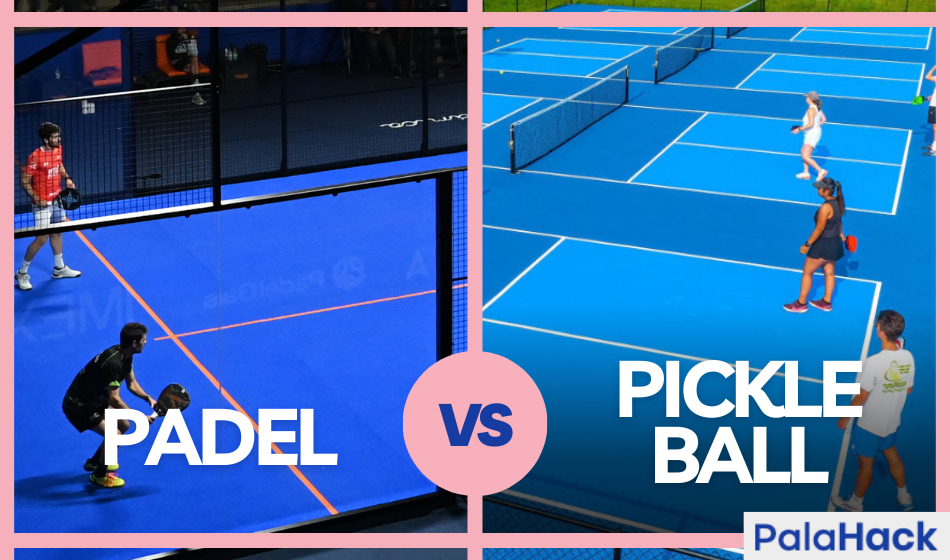
The Geometry of the Game: The Glass vs. The “Kitchen”
The most radical difference is not in the hand, but in what surrounds the court.
- In Padel: We play in three dimensions. The glass is your best friend or your worst nightmare. As I always tell you, learning to let the ball pass and play with the rebound is what takes you from intermediate to advanced level. The geometry is circular, with constant defense-attack.
- In Pickleball: There are no walls here. If the ball passes you, the point is over. But beware, they have the “Non-Volley Zone” or “Kitchen”. This changes the game completely. You can’t smash at the net just any way; it forces you into a game of patience, of “dinks” (soft shots), very similar to our “chiquitas,” looking for the opponent to lift it so you can attack.
The Material: Carbon and Rubber vs. Honeycomb
This is where we get technical. Many of you ask us: “Can I play with my padel racket?”. Don’t even think about it, team! You’d ruin the racket and wouldn’t hit a thing.
- The Padel Racket: We look for EVA or FOAM cores, with carbon faces (3K, 12K, 18K…). They weigh between 360 and 375 grams. We seek balance, ball output, and that “sweet spot” we obsess over.
- The Pickleball Paddle: It’s much lighter (about 220-250 grams). It doesn’t have holes (except for some experimental models) and its core is usually a polymer with a honeycomb structure. Being so light, wrist play is frenetic, but you don’t have the leverage of a padel racket for the x3 smash.
- The Ball: This is key. In padel, we play with pressure, with a ball that “lives” and is affected by humidity and altitude (as we can see in tournaments like the one in Mexico). In pickleball, the ball is plastic with holes. The wind is its biggest enemy, and the timing of impact is completely different. There’s no “sticky effect” from courts with high humidity.
Biomechanics and Injuries: Which is more “friendly”?
You know that at the academy we emphasize physical preparation. At 40 years old, my knee and shoulder rule.
- Padel: It’s a sport of intensity peaks. Turns, explosive starts, and a lot of play above the head. The elbow suffers if the racket is very hard or the balance is too much at the tip (like in radical power rackets).
- Pickleball: The impact is less because there aren’t as many long movements or extreme power smashes. It’s very lateral and reflex-based. It’s ideal for people who want to keep competing but whose knees have already said “enough” to the mud of the World Padel Tour. Still, watch out for the Achilles tendon, as short starts are treacherous.
The Mental Factor: The transition of the padel player
If you’re a padel player and you step onto a pickleball court, you’re going to make a typical mistake: wanting to hit everything.
In padel, if you have a comfortable ball above, you take it out for three. In pickleball, if you hit a “whack” to a ball that comes with spin, you’re most likely to send it to the fence of the neighboring club. The padel player stands out in pickleball for their volley and net sense, but suffers because they lack the wall to defend deep balls. It’s a lesson in tactical humility: you have to learn to play slow to win fast.
Investment and Future: Is there room for both?
As we discussed in this article, the growth of padel is unstoppable globally, especially in Europe and the Middle East. Pickleball is the absolute king in the United States.
Our professional opinion? They are not mutually exclusive. Pickleball is incredibly easy to learn (in 15 minutes you’re playing a decent match), which makes it very social. But padel has that tactical depth and the spectacularity of the game with walls that, honestly, is hard to beat.
If you’re looking for adrenaline, complex geometry, and that dry carbon sound when hitting a viper, padel is your place. If you’re looking for a social sport, with quick reflexes and where the learning curve is lightning-fast, give pickleball a try.
For now, we’re not letting go of our padel racket for anything in the world, but we love that the racket sports ecosystem is growing. The more people on the courts, the better for everyone!
Have you tried Pickleball yet? Have you experienced trying to hit a wall that wasn’t there? Leave it in the comments, I want to have a laugh with your anecdotes. I’ll read you!
And you know, if you want to improve your padel (or your knowledge of materials), follow us. See you in the next chapter!

PalaHack
We got the bug for this wonderful sport more than 10 years ago.
We want you to feel that, when you read one of our analyses, it is like receiving advice from those friends with whom you share the court every weekend. If something is not clear or you want to know more, do not hesitate to ask!