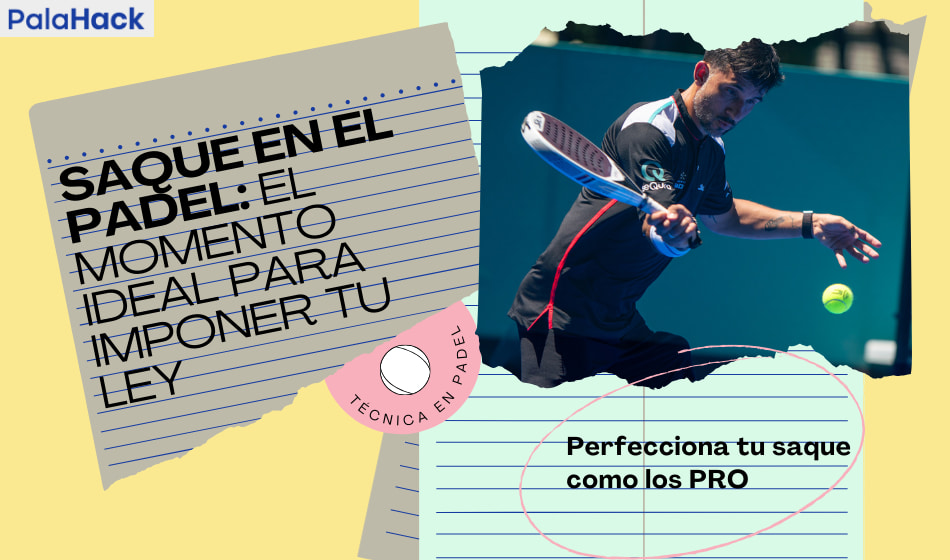
Padel Serve: Perfect Your Serve Like the Pros
28 de January de 2026 | Updated 17 de April de 2026
The serve is the most underrated shot by amateur players. It is the only moment in the match where you have absolute control over the ball: you decide when, how, and where, without the opponent being able to intervene until the return. Therefore, it’s not enough to just “put the ball in play”; we aim to start the point dominating.
Based on the technical analysis of experts like Manu Martín and the observation of players like Juan Lebrón or Martín Di Nenno, we break down the mechanics of the serve so you can go from “serving” to “threatening”.
Step by Step: Technique Behind a Good Serve
To execute an advanced level serve, we must go beyond simply hitting the ball. The key lies in weight transfer and the height of impact.
Positioning on Court
It’s not just about standing behind the line and that’s it. The initial position dictates your angles and your net coverage.
Lateral Distance
The standard is to stand approximately 1.5 or 2 meters from the side wall. If you stand too close to the glass (as Paquito Navarro sometimes does on the backhand), you open a lot of angle towards the opponent’s side wall, but leave your center exposed. If you stand too close to the “T” (like Di Nenno playing the Australian), you cover the middle better but lose cross angle.
Foot Position
- Static Serve: Feet parallel or the opposite foot slightly forward, without prior movement. Ideal for beginners seeking total control.
- Dynamic Serve (Lebrón Style): Start with feet apart. The support foot (left for right-handers) does not move, acting as a pivot. The right foot advances while you bounce the ball forward. This allows us to impact with the body already leaning towards the net, gaining momentum and reducing the time to reach the volley position.
The “Active Bounce” and the Point of Impact
This is where 90% of amateur errors lie. Don’t let the ball drop; throw it against the ground.
- Strong Bounce: We recommend throwing the ball with intention against the ground so that the rebound is high. The rules allow hitting up to the height of the waist (not the hip). If you let it drop dead, you’ll hit at knee height, forcing you to lift the ball (easy lob). If you bounce it hard, you can impact at the highest allowed point, achieving a descending (offensive) angle that makes the return difficult.
- Bounce Distance: In the dynamic serve, the ball should bounce almost two meters in front of your initial position so you can walk towards it and hit it in front.
Use of the Arm and Preparation
Forget about wrist flicking. Control comes from stability, not the hand.
- Short Preparation: Like in the volley, don’t take the racket behind your head. The preparation is short and compact.
- Weight Transfer: The power is not generated by the arm doing a “whip”, but by the transfer of body weight (kinetic chain) from the back leg to the front leg as you walk towards the ball. The arm simply accompanies and directs that momentum.
- Firm Wrist: A common mistake is trying to direct the ball by turning the wrist at the last second. This causes inconsistency. The wrist must be firm to transmit the weight to the ball.
Serve Direction: The Body is the Sight
How do we direct the ball to the “T” or the glass without using the wrist? With the ball toss and body orientation.
- Serve to the “T” (Center): Toss the ball a little more forward and align your shoulders towards the center. By impacting further forward, the natural trajectory will cross the ball towards the T.
- Serve to the Side Glass: Toss the ball a little closer to your body or delay the impact by milliseconds. By hitting a little later (“letting it come in”), the racket face will send the ball towards the open side wall.
Note: If you try to change direction only with the wrist, you will fail or telegraph the serve. Use your body as a block.
Reading the Opponent and Tactics
Don’t serve automatically. Before hitting, look where the returner is and talk to your partner.
Communication
You must inform your partner: “I’m serving to the T” or “I’m serving to the glass”. If you serve to the T, your partner must close the center to avoid the easy passing; you cover your parallel. If you serve to the glass, your partner covers the parallel and you close the center.
Varying Depth
- Deep Serve: Aim for the rebound on the back glass. Force the opponent to move backward, giving you more time to take the net.
- Short Serve: If the opponent returns very well from the wall or the court is fast/wet (the ball slides and rises), try serving shorter and softer. This will force the opponent to lift the ball without the help of the glass, preventing them from counterattacking with a strong bajada.
The Psychological Factor
If you see that a serve bothers them (for example, to the backhand or the body), repeat it until they show they can solve it. Don’t change a winning strategy just to “vary” if it keeps giving free points.
Types of Serve
There is no best serve, there is the serve that hurts your opponent the most at that moment. The mistake is to automate the service and always serve the same way. To dominate, we must handle a range of options that vary according to direction, depth, and placement on the court.
We break down the types of serves you should have in your arsenal to destabilize the returner.
Classification by Direction
Direction is the first tactical decision and conditions the movement of the entire pair.
Serve to the “T” (To the Center):
- Objective: We aim for the center line to force the returner to move towards the middle. This opens up space on their parallel and creates doubts about who should cover the center if the return is poor.
- Tactical Consequence: By serving to the T, our position and that of our partner must adjust. If we serve to the center, we close the middle more to prevent them from winning the net there, which is the area of greatest confidence and security for the opponent.
Serve to the Side Glass (Open):
- Objective: We aim for the ball to bounce in the box and then hit the side wall (or the mesh if we risk it). This forces the opponent to move laterally, opening gaps in the center of the court.
- Coverage: If we serve to the glass (to the right of the right-handed opponent), our partner must be very attentive to cover the parallel, while we cover the center.
Serve to the Body:
- Objective: Embed the ball into the returner’s body so they can’t extend their arm and “eat” the ball. It is very effective against tall players or those with a very wide and slow preparation.
Classification by Depth
This is where the advanced player makes a difference. You don’t always have to aim for the back of the court.
Deep Serve (The Classic)
- We aim for the ball to bounce near the service line and then hit the back glass.
- The Risk: If the opponent is good at managing rebounds (like Sanyo Gutiérrez), a deep serve gives them more time to prepare the return and counterattack, as the ball comes off the glass and is comfortable for them.
Short Serve (The “Chiquita” Serve):
- When to use it: At PalaHack we recommend this variant especially in winter or when the ball is heavy and doesn’t bounce. It is also lethal when the glass is wet and the ball slides.
- Execution: We serve softer and shorter, aiming for the ball to bounce earlier and force the opponent to lift it “on the rise” or without the help of the wall. If we manage to make the ball bounce and die before reaching the glass (the “3 bis” trick), we nullify the opponent’s double wall defense.
Classification by Server Placement
The rules allow us to move along our service line, and that changes the angles.
Closed Serve (From the Center):
This is what Martín Di Nenno uses when playing the Australian. He positions himself close to the center line (even invading the projection with the impact, watch out! from 2026 with the FIP rule change this will not be allowed, you can read more here) to cover the shortest distance possible to his coverage position at the net. It covers the middle very well but loses angle to aim for the side mesh.
Open Serve (Close to the Glass)
If we position ourselves 1.5 or 2 meters from the side glass, we open the angle to aim for the opponent’s side wall more easily.
- Danger: By opening up so much, we leave our center exposed and take longer to cover the central volley.
Serve Tactics
The serve is the first attack shot, and like a good chess game at PalaHack we know that a good technical gesture without tactical intention is like a sports car without a steering wheel: a lot of power, but no direction. The serve is the only moment in the match where you depend solely on yourself, without the opponent conditioning you beforehand, so it’s the ideal moment to impose your law.
Communication: The Basis of Coverage
Before even bouncing the ball, the tactic begins with your partner. It’s an amateur mistake to serve “to see what happens”.
The Code
You must communicate (by speaking or with signals) where you are going to serve: “I’m serving to the T” or “I’m serving to the glass”.
Space Coverage:
- Serve to the Glass (Open): If you are right-handed and serve towards the opponent’s side wall, your partner (who is at the net) must stick closer to the mesh to cover the parallel, while you move up to close the center.
- Serve to the T (Center): If you aim for the center, the geometry changes. Your partner must close the middle a bit more and you cover your side. The main goal is that the ball doesn’t pass us through the center, which is the area of greatest safety and confidence for the opponents.
Consequence
If you don’t warn and change direction at the last minute, your partner will be poorly positioned and you will leave huge gaps.
Managing Depth and Weather
A deep and fast serve is not always the best. At PalaHack we analyze the conditions to decide:
The Deep Serve
We aim for the ball to bounce near the line and then hit the back glass. This forces the returner to wait and gives us more time to move up and stick to the net.
The Short Serve (Weather Factor)
In winter, with humidity or with heavy balls, the deep serve is a mistake because the ball doesn’t come off the glass and is comfortable for the opponent. Here the tactic is to serve shorter and softer on the forehand or backhand.
- Why? Because if the ball doesn’t bounce off the wall, you force the opponent to lift it “on the rise” or play a low and complicated ball, preventing them from using the rebound to counterattack.
Variability
If you always serve the same, the opponent adapts. If you see that an opponent like Sanyo Gutiérrez manages the wall rebound well, change the depth and play a short one at their feet to make them doubt.
Server Positioning
Where do I serve from? The initial position conditions the angle and the approach to the net.
- Standard Position: The usual is to stand about 1.5 or 2 meters from the side wall. It’s the perfect balance between covering the center and having an angle.
- Open Up (Close to the Glass): If you stand very close to your side wall, you create a brutal angle to aim for the opponent’s mesh. Being so open, it takes longer to cover the center of the net and leaves a huge corridor on your parallel if the return is fast.
- Close In (Close to the T): Typical in the Australian formation (as Martín Di Nenno does). You position yourself in the center to cover the shortest distance possible to the side you have to cover at the net, minimizing the risk of being caught in the cross.
The Golden Rule: Always Move Up
It seems obvious, but at amateur levels (and in streamer tournaments as we saw with Kolderiu), many players serve and stay watching or stay in the middle of the court (“swamp zone”).
- The Tactic: The serve is just the pretext to gain the net. If you serve and don’t move up, or move up halfway, you give the initiative to the opponent.
- Pro Tip: If you struggle to get there, serve slower. A slow serve gives you more time to reach a good volley position before the opponent impacts. It’s preferable to have a mediocre serve with a good net position than a powerful serve that catches you in the middle of the court.
Reading the Opponent (Pain Points)
Tactics are also psychological.
- Punish the Weakness: If you notice the opponent struggles with the backhand close to the glass, keep targeting there. But be careful, if you do it 3 times in a row, by the fourth they’ll be waiting for you. The smart tactic is to alternate: give them one to the body or to the T so they don’t get comfortable and then go back to punishing their weak point.
- Return to the Player Moving Up: If you are the one returning (the counter-tactic), try to play the ball to the player who just served and is moving up. Coming in motion, it will be harder for them to stop and volley with precision than for their partner who is already static at the net.
Our tactical conclusion is clear: The serve is not to win the point (Ace), it’s to win the net. Use direction and depth to make the opponent’s return uncomfortable and leave you an easy first volley.
Australian Serve
The Australian serve involves each player maintaining their side of the court (forehand or backhand) throughout the point, regardless of where the serve is made from.
- Advantages: Allows specialization. If you are a pure backhand player, you don’t have to play points on the forehand. It avoids uncomfortable situations like having two backhands in the center if a lefty plays with a righty and also manages the game dynamics in the same way.
- Disadvantages: Possible physical wear on the server, who must run diagonally to cover their position after the serve, momentarily leaving a gap on the parallel. If not done correctly, you will be leaving a very large corridor.
When to Break the Australian?
If the opponents are doing a “nevera” (playing everything to one player), breaking the Australian forces the opponents to change the direction of their shots constantly, breaking their tactical rhythm.
Serve Regulations
The serve is, by far, the maneuver that generates the most controversies in amateur padel. We clarify the gray areas based on the FIP regulations:
- Waist, not hip: The legal height limit is the waist. Many players try to “cheat” this by crouching at impact or standing on tiptoes to raise the reference of their waist.
- Impact in front of the line: It is legal to impact the ball within the projection of the service box (invading the field), as long as the feet remain behind the service line at the moment of impact and both feet do not leave the ground (jump) before hitting. Note 2026 update: Although currently allowed, it is rumored that future regulations may prohibit invading the box on impact to curb players who abuse this to gain the net.
- Direction: The serve must be crossed diagonally, but the regulations allow for such precision that the serve can be almost parallel if hit from the edge of the center line.
At PalaHack we recommend training the dynamic serve. Gaining half a meter in the approach to the net can be the difference between volleying an easy ball or having to block a bajada at your feet.
We hope you enjoyed this guide on the serve and start applying it in your upcoming matches. Feel free to leave any questions in the comments.
PalaHack
We got the bug for this wonderful sport more than 10 years ago.
We want you to feel that, when you read one of our analyses, it is like receiving advice from those friends with whom you share the court every weekend. If something is not clear or you want to know more, do not hesitate to ask!