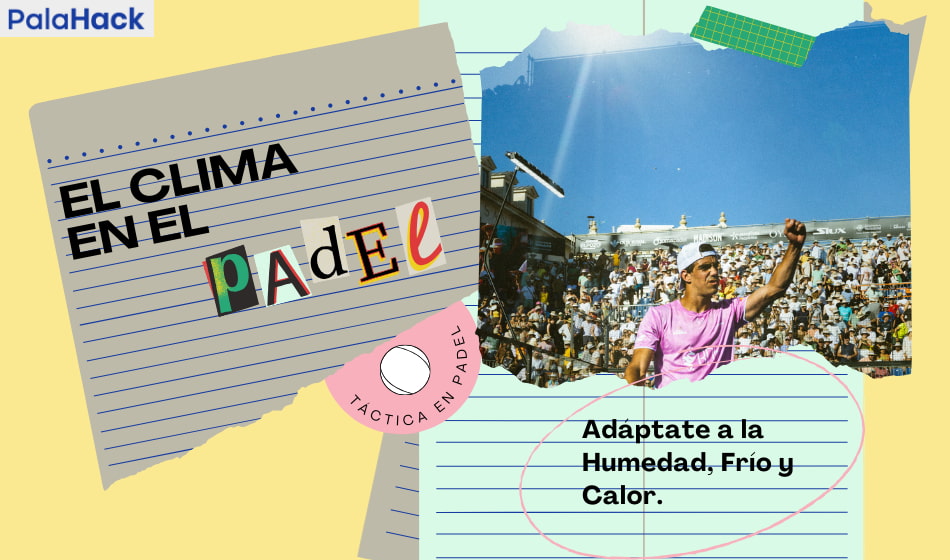
How Weather Affects Padel Play: The Ultimate Adaptation Guide (Humidity, Cold, and Heat)
28 de January de 2026 | Updated 17 de April de 2026
Many amateur players get frustrated because “today the ball doesn’t move” or because “the racket feels like a board,” without understanding that weather radically alters the physics of padel.
After analyzing the behavior of materials and tactics in tournaments from Valladolid to Puerto Cabello, we technically break down how temperature, humidity, and altitude transform your match and, most importantly, how you should adapt your game and equipment to not lose competitive advantage.
Temperature: The Engine of Reactivity
Ambient temperature is the factor that most directly influences the two elements we interact with: the racket and the ball.
Heat: Expansion and Fast Play
When we play in summer or in high-temperature conditions (above 25-30ºC), two physical phenomena occur:
- The Rubber softens: The core of the racket (whether EVA or Foam) expands due to the heat. This causes the racket to feel more “chewy” or soft. At low speed, the ball comes off a lot (spring effect), but at high speed, we can feel that the racket “eats” the ball and we lose a bit of control or direct power due to excess energy absorption.
- The Ball Pressure increases: The gas inside the ball expands, making the ball more lively and bouncy.
Our tactical recommendation? If you’re a hitter, it’s your moment. If you’re looking for control, you’ll need a harder racket (like a Metalbone HRD or a Technical Viper) to compensate for the softening of the rubber due to the heat.
Cold: Contraction and “Board Effect”
In winter (below 10-12ºC), the opposite happens. Materials contract and harden.
- The Racket hardens: A medium-touch racket in summer can feel like a real board in winter. The sweet spot seems to shrink and the ball doesn’t come off unless we apply force.
- The Ball “dies”: The internal pressure drops and the rubber of the ball becomes rigid. The ball feels heavier and bounces less.
Our tactical recommendation? In winter, we recommend lowering the weight of the racket or using softer rubbers (Soft or Ultrasoft) to help with ball output, as the racket won’t give us anything for free. Tactics like the smash over three meters become very difficult; it’s better to opt for the víbora or the deep bandeja.
Altitude: Madrid vs. The Coast
This is one of the factors that most confuses amateur players. Why in Madrid (600m altitude) is the game very fast and in Alicante or Valencia (sea level) does the ball seem like lead?
- At Altitude (Lower atmospheric pressure): There is less air resistance. The ball travels faster and floats more. The aerial game is lethal; any decent smash returns to your court or goes out over three. Here, control rackets help manage that excess speed.
- At Sea Level (Higher atmospheric pressure): The air column “crushes” the ball. The ball feels heavy and is hard to move. Here the game becomes more physical and tactical, working the point (“pick and shovel”), because defining with a smash is much more complex.
Humidity: The Enemy of Glass and Spin
Humidity is, in our opinion at PalaHack, the most disruptive factor, especially on poorly air-conditioned indoor courts or coastal areas. It affects in three critical ways:
The Heavy Ball
The felt of the ball absorbs ambient humidity like a sponge. This increases the mass of the ball, making it heavier and slower. Forget about hitting it over three meters unless you’re a physical powerhouse; the ball simply won’t rise after impact on the glass.
The “Drama” of the Glass
When there’s condensation on the glass, the bounce changes the physics of the game.
- The ball doesn’t bounce, it slips: When hitting the wet glass, the ball falls straight to the ground (slip effect) instead of bouncing off.
- Tactical Adjustment: In these conditions, playing deep is a risk. We must shorten our shots to avoid the ball touching the glass, or play softer. If we’re attacked, the recommendation is not to let the ball hit the wall; we must anticipate and volley or block earlier, because if it touches the glass, the point is lost.
The Surface of the Racket
The face of the racket gets wet, creating a film of water that nullifies friction.
• Goodbye to spin: If you try to hit a víbora or a sliced volley with a wet racket, the ball will slide over the face and shoot off uncontrollably or go into the net. On very humid days, we recommend playing flat and to the center, forgetting technical slices.
Wind: The Outdoor Factor
When we play outdoors, the wind affects the lob, which is the most tactical shot in padel.
- Wind in favor: The lob goes to the back glass. You have to hit tighter and faster lobs.
- Wind against: The lob falls short and we get smashed. You have to push the ball harder and use your legs to give it depth.
Strategy
Identifying the wind direction (by looking at flags or trees) is vital to choose the side of the court in the toss or adjust the strength of the lob.
Adapt Your Equipment
You can’t play the same in August as in January. From PalaHack, based on our experience testing equipment, we suggest:
- Summer/Heat: Use rackets with denser carbon (12K, 18K) and medium-high density rubbers to maintain control when the ball flies.
- Winter/Cold: Opt for rackets with fiberglass or 3K carbon with soft rubbers (Soft/Eva Soft) that provide comfort and ball output when the weather hardens the touch.
In any case, we know that each situation is unique, and it’s important to have enough information to improve our game and experience. That’s why we recommend you don’t miss our guide on how to choose a padel racket.
Frequently Asked Questions (FAQ)
- Why does my racket sound different on the coast than inland? Humidity and pressure affect the density of the rubber and the surface tension of the materials. On the coast, with humidity and heat, the racket can sound deeper (like a drum) and feel softer, while in dry and cold weather it sounds drier and stiffer.
- What is the “serve 3 bis” and why use it with humidity? It’s a tactic that involves serving shorter and softer aiming for the side wall. If the glass is wet, the ball will slip and die when it hits the wall, making it impossible to return. If you serve deep and hard, the ball might lift or make the return easier.
- Should I put the racket in the freezer or fridge in summer? Although some professional players do it in extreme situations to temporarily harden the rubber, we don’t recommend it for amateur players. Sudden temperature changes (thermal shock) degrade the rubber and shorten the racket’s lifespan. Ideally, use a thermal cover and don’t leave it in the car trunk.
PalaHack
We got the bug for this wonderful sport more than 10 years ago.
We want you to feel that, when you read one of our analyses, it is like receiving advice from those friends with whom you share the court every weekend. If something is not clear or you want to know more, do not hesitate to ask!