Smash x4 in Padel: Tactical Reading Over Power
29 de January de 2026 | Updated 17 de April de 2026
The “por 4” is often associated exclusively with brute force. However, legends like Fernando Belasteguín have shown us that the art of this shot is, above all, a triumph of tactical intelligence.
Taking it out over four meters is not just about hitting hard; it’s about knowing when to hit, you have to be “smart” to execute this shot well. Below, we break down this definitive shot so you understand the real mechanics behind the spectacle.
What is the Remate X4 in padel
The remate por 4 is a finishing shot where the objective is for the ball, after bouncing on the opponent’s court, to exceed the height of the back mesh, which is regulated to be 4 meters (on glass courts) or the back wall on traditional wall courts.
What distinguishes this shot is that the point ends immediately the moment the ball surpasses that height. Unlike the remate por 3, where the opponent can exit through the door to recover it, in the por 4, if the ball passes the back fence, the point is over.
Although it’s a shot that amateur players love to attempt, it doesn’t require as much technical execution skill as it does an impeccable tactical reading to be positioned near the net at the exact moment.
Step by step of the remate X4
To successfully execute an X4, the sequence doesn’t start with the smash, but with the previous shot and the reading of the game.
The Preparation (The previous shot)
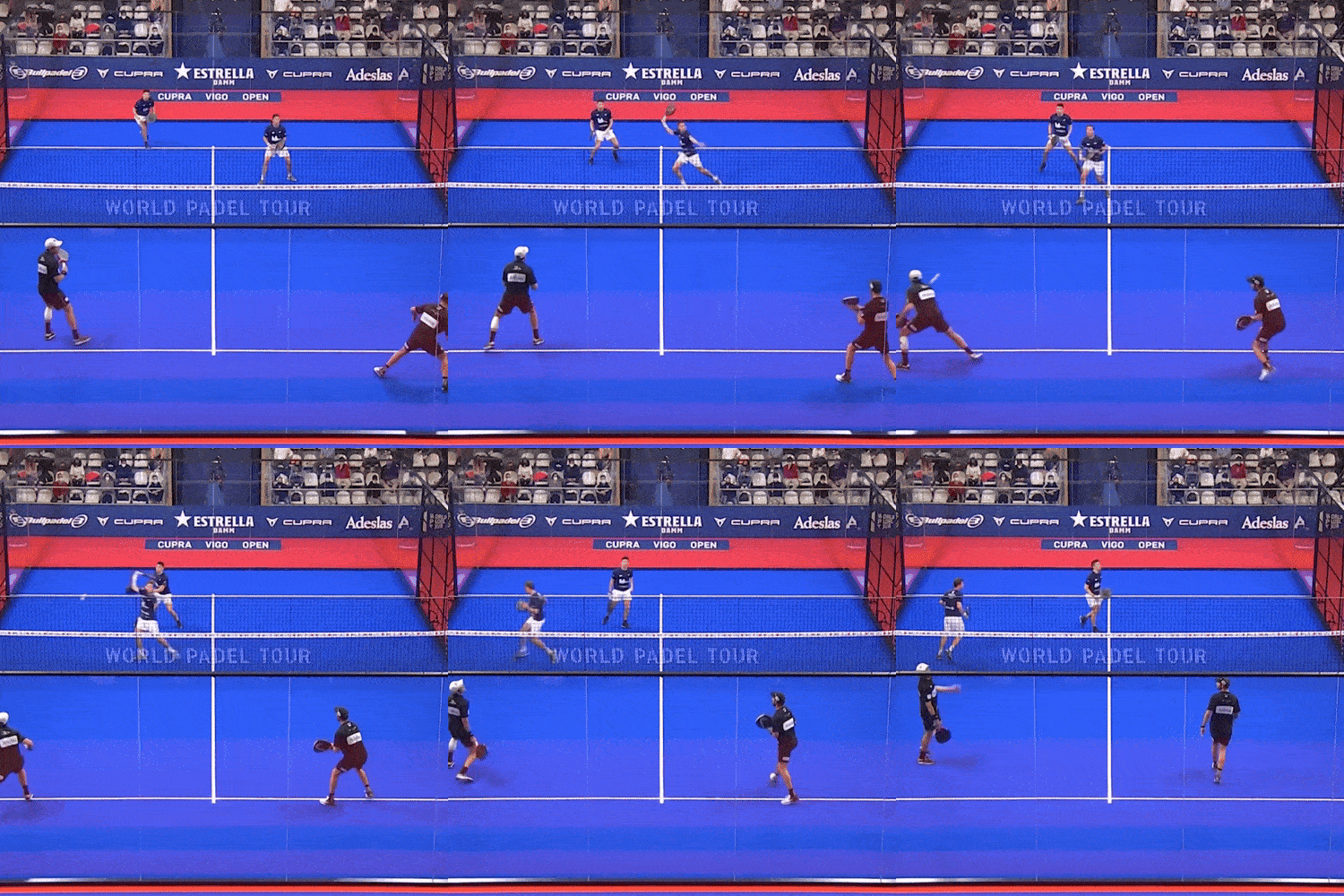
It all starts with a pressure shot, like a deep volley to the feet (as in the gif above) or to the corner. If we don’t generate prior damage, the X4 won’t exist.
The Reading and Anticipation
Seeing that the opponent is in a critical situation (ball at the feet, no bounce), the player at the net reads that the return will be forced and floating.
The Advance (Getting close to the net)
Here’s the key. The player advances decisively and gets almost to the net (be careful not to touch it as it’s a lost point). If you stay mid-court, the ball will drop, and you won’t be able to take it out for four.
The Short Preparation
Being so close to the net and with little reaction time, the preparation must be in front and short. We can’t take the racket back like in a power smash from the back.
The Definition
The ball is hit at its highest possible point, hitting it downwards with force so that the bounce surpasses the back wall, and once again, keeping in mind not to touch the net at any time and always having let the ball pass to our side, as we cannot hit it to the other side of the court unless it comes from our side previously (as can happen in a smash that bounces with great force).
When to execute it
The X4 is a shot of opportunity, not construction. You should only attempt it in very specific situations where the reading of the game allows it.
- When the opponent “gets rid of the ball”: If we’ve pressured well, the opponent can often only block or lift a ball without control. That “dirty” or floating return that dies near the net is the ideal candidate.
- When the ball is above the net: If the opponent manages to lower the ball and forces us to volley below the waist, the X4 is impossible. We need height to hit the ball.
- Reading the bounce: We must be sure that the previous shot has done damage. If the opponent is comfortable, trying to get close to the net to look for an X4 is a tactical suicide, as they can easily lob us or play a chiquita to the feet.
Typical X4 mistakes
Analyzing failed plays and successes, we detect recurring mistakes in amateur players:
- Excessive preparation at the net: One of the most technical errors is taking the arm too far back when approaching the net to define. With less reaction time, if we prepare long, we’ll be late to the impact.
- Suicidal anticipation: Many players rush forward (“recklessly”) expecting the opponent to leave the ball easy, without having generated prior damage. If the opponent defends well (as we saw in a play by Franco Stupaczuk defending an impossible ball), and you’re glued to the net waiting for the X4, you’ll be left exposed and lose the point.
- Poor reading of the quality of the previous shot: Believing that we’ve hit a good bandeja when in reality it was comfortable for the opponent. If the opponent has options, they won’t give you the ball to take it out x4.
Useful tips to improve the remate X4
To master this shot, at PalaHack we recommend focusing on tactics rather than strength:
- Reduce the preparation: When you identify the opportunity and run towards the net, keep the racket prepared in front. The gesture should be compact.
- Analyze your partner: If your partner (like Bela) has a bandeja that “kills” the ball at the opponent’s feet, you must be ready to step forward and catch the return. The opportunity is generated by him, you just execute it.
- Watch the opponent’s feet: If you see that the ball is going to bounce at their feet and they’re uncomfortable, it’s your green light to advance and close the angle. If you see they’re going to hit comfortably, maintain your position and don’t rush.
Frequently Asked Questions
- Is taking it out por 4 the same as por 3? No. In the remate por 3 the ball exits laterally through the 3-meter wall and the opponent can exit the court to recover it. In the remate por 4, the ball surpasses the back wall (4 meters) and the point ends instantly, as it is considered won by the rules.
- Do I need a lot of strength to take it out por 4? More than strength, you need positioning. If you’re close to the net and the ball is high, it’s easy to take it out by hitting it downwards. If you’re mid-court, you’ll need enormous strength that often leads to error. The key is the position.
- Can the X4 be trained? Yes, but don’t just train the smash. Train the transition: hit a good bandeja, read the opponent’s poor return, and sprint forward to define. That is the real match movement.

PalaHack
We got the bug for this wonderful sport more than 10 years ago.
We want you to feel that, when you read one of our analyses, it is like receiving advice from those friends with whom you share the court every weekend. If something is not clear or you want to know more, do not hesitate to ask!