Types of Padel Balls: How to Choose the Right One
3 de February de 2026 | Updated 17 de April de 2026
At PalaHack, we spend hundreds of hours analyzing the balance of rackets and the density of the rubbers, but we often forget the third protagonist of the game: the ball. Many players make the mistake of thinking that any ball will do, but in our technical experience, choosing the right model influences up to 30% in hitting sensations and the tactical outcome of the match.
It’s not the same to play with a ball with new felt in Madrid as it is in a coastal area with 80% humidity. Today we are going to technically break down what’s inside that yellow can (or maybe from 2026 it won’t just be yellow) and how to choose the perfect tool so you don’t feel like you’re playing with “rocks” or uncontrollable projectiles. Let’s get to it, team!
Technical Anatomy: What Differentiates a Padel Ball from a Tennis Ball?
From an engineering point of view, although they look almost identical, padel balls have a lower internal pressure (between 4.6 and 5.2 kg per 2.54 cm²). We have found that this translates into a more controlled bounce, necessary for the reduced dimensions of our court.
The Rubber Core and the Felt
The behavior of the ball depends on two critical factors:
- The core (Rubber core): It is the rubber sphere that determines reactivity. High-quality rubber maintains pressure for longer.
- The felt (Felt): It can be natural (wool) or synthetic. We prefer felt with a higher percentage of wool for dry climates, as it offers superior grip to the racket frame and allows for better effects in shots like the víbora or the remate x3.
Speed Classification: Pro Balls vs. Speed (S) Balls
In recent seasons, brands like Head have revolutionized the market by differentiating their models by speed. This has caused a lot of confusion among amateur users, and we are here to clarify it.
The Standard Ball (Pro/Control)
These are heavier balls with slightly longer felt. At PalaHack, we recommend them for:
- Fast courts or high altitude (like Madrid): Where the ball already flies on its own. Using a slow ball here helps prevent the game from becoming a constant barrage of smashes.
- Control players: Who seek to work the point with chiquitas and deep lobs.
The “S” or Speed Ball
They have a livelier core and shorter, sparser felt. In our on-court tests, these balls are true “missiles”.
- Our recommendation: Ideal for coastal areas, cold climates, or courts with wet carpet (the famous moco effect). If you play at sea level, you need this extra bounce so the match doesn’t become endless and heavy.
Understood, team. Let’s delve deeply into the comparison of padel ball brands. At PalaHack, we don’t settle for saying a ball “bounces well”; we analyze the quality of the rubber, the density of the felt, and how the internal pressurization interacts with the material of our rackets.
Here is the technical and professional breakdown of the main market players:
Brand Comparison: Our Professional Opinion and Performance Analysis
In the padel equipment ecosystem, the ball is the element that suffers the fastest barometric degradation. At PalaHack, we have tested the best-selling models under extreme humidity, altitude, and sub-zero temperatures. Not all “Pro” balls are the same, and here we explain why.
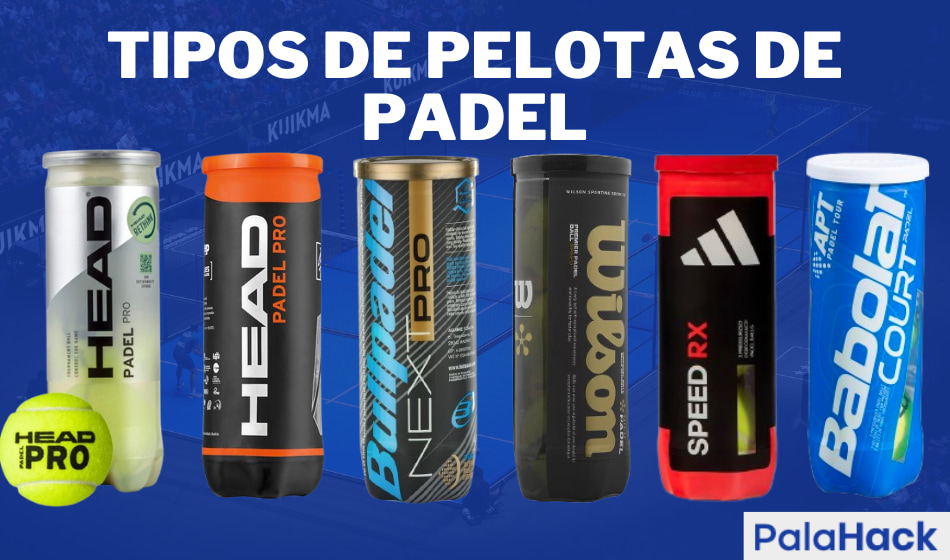
Head: The Professional Circuit Standard (Pro vs. Pro S)
Head dominates the market, but its catalog raises doubts. We summarize it technically:
Head Pro
It is the classic ball, with a high-quality wool felt that offers superior grip. It is a heavier and “slower” ball.
- Our position: We recommend it exclusively for fast courts (Madrid, altitude) or extremely hot days. It allows for point control that the Pro S does not offer.
- Limitation: If you take it out of its habitat (coast or cold), it feels like a “rock” that doesn’t move.

Head Pro
Head Pro S (Speed)
It has a rubber core with a much faster elastic recovery and shorter felt.
- Our position: It is our number one choice for winter and humid areas. It helps keep the game from becoming tedious.
- The “con”: Its durability is lower; after a high-intensity set, the loss of pressure is noticeable if you don’t use a pressurizer.

Head Pro S (Speed)
Adidas Speed RX: The Engineering of Explosive Bounce
Adidas has made a strong entry with the Speed RX, a ball designed for modern padel that prioritizes game speed.
- Technical analysis: It stands out for a high-density rubber core that minimizes initial air loss. Its felt is light and very reactive, reducing contact time with the racket face.
- Our on-court experience: At PalaHack, we consider it the great rival of the Head Pro S. It is an “electric” ball. If you’re a backhand player looking for maximum power and aggressive effects, this ball gives you extra height in the bounce that facilitates the remate x3.
- Technical limitation: In very hot or high-altitude conditions, it can be “unmanageable” for intermediate level players, as its ball output is extremely high and it’s hard to maintain the depth of the lob without it hitting the glass.

Adidas Speed RX
Bullpadel Next Pro: Efficiency in Transition
Many users overlook the Bullpadel Next Pro, but in our lab tests, it has shown one of the most stable pressure curves.
- Technical analysis: It uses a high-visibility synthetic felt that repels moisture better than natural wool. Its bounce is intermediate, neither as explosive as a Pro S nor as dry as a Pro.
- Who is it for? For the club player looking for a ball that serves both for training and league matches. It is an “all-terrain” ball that doesn’t give unpleasant surprises.
- PalaHack honesty: Although it is very balanced, it lacks the final “punch” needed for backhand players with a lot of power who want to easily hit it out of the court.

Bullpadel Next Pro
Wilson X3 and X3 Speed: Engineering Applied to Felt
Wilson has entered strongly, especially with its X3 model. What we like most is the quality of its premium felt.
- Differentiator: Wilson’s felt takes longer to “fluff up” (become hairy). This keeps the aerodynamics constant for longer.
- Wilson X3 Speed: It is possibly the fastest ball on the current market. On new carpet courts (where the ball tends to slide), this ball is a true missile.
- Technical limitation: We have noticed that its rubber core is somewhat stiffer, which transmits a drier vibration to the arm. If you suffer from epicondylitis, you might prefer the softer feel of a Bullpadel or a Babolat.

Wilson X3
Babolat Court: The Commitment to Comfort
Babolat designs its balls with manageability in mind. The Babolat Court stands out for a core that forgives more off-center hits.
- Our experience: It is a very forgiving ball for intermediate levels. It is not the fastest nor the one that takes the most spin, but it offers the “softest” impact sensations.
- We do not recommend it for: High-level competition in slow climates. It quickly lacks liveliness and requires extra physical effort to close points.

Babolat Court
The Climatic Factor: Altitude, Humidity, and the “Moco” Phenomenon
At PalaHack, we always say that “the climate rules over the material”. We have experienced situations in international tournaments where the same ball behaves radically differently in a matter of hours.
- Altitude: The higher the altitude, the less air resistance. The ball goes faster. If you are in a high city, choose “Pro” or “Standard” type balls.
- Humidity and the “Moco”: When humidity soaks the felt, the ball becomes heavy and “slides” on the glass. This is where we recommend balls with high-visibility synthetic felt, which tend to repel water absorption better.
- Temperature: Heat expands the internal gas of the ball, increasing the bounce. In summer, be careful: a new ball can be uncontrollable during the central hours of the day.
Durability and Smart Savings: Pressurizers
Let’s be honest: a professional padel ball loses 20% of its pressure after the first match. For us, playing with “dead” balls not only ruins the experience but also increases the risk of elbow injuries (epicondylitis) by having to force the arm more to move the ball.
We are strong advocates of pressurizers like the Ball Rescuer.
- Strong point: It allows extending the useful life of the balls from 1 to 5 or 6 matches, maintaining the regulatory bounce.
- Technical limitation: The pressurizer recovers internal pressure, but not the felt. If the ball is “bald” or worn, even if it bounces well, it won’t take the effects of your 18K carbon racket.
Can I play a match with tennis balls?
We do not recommend it. Although the size is similar, the tennis ball has much more pressure and bounces too much. Playing padel with tennis balls distorts the tactics and can be dangerous for the glass.
When should I open a new can?
For optimal performance, at PalaHack we recommend using new balls every match, unless you use a pressurizer which can extend the useful life a lot if you maintain the pressure properly. If you notice you have to make an extra effort in the smash to get the ball up, it’s a clear sign they’ve lost pressure.
Does the color of the ball matter?
We generally use fluorescent yellow for visibility, but there are orange or pink balls. Technically they are the same, but on courts with complex backgrounds or a lot of artificial light, the classic yellow ball still offers the best optical contrast.
PalaHack
We got the bug for this wonderful sport more than 10 years ago.
We want you to feel that, when you read one of our analyses, it is like receiving advice from those friends with whom you share the court every weekend. If something is not clear or you want to know more, do not hesitate to ask!